Art making ideasi

Ideas. Inspiration. A little creative mischief.

If you’re drawn to abstract and semi-abstract art, sketchbooks, colour and a little creative mischief, this is your corner of the internet.

Here you’ll find stories, videos, inspiration, art making advice and gentle nudges to help you create art that feels exciting to you.

My favorite types of sketchbook

Some of my favorite types of sketchbook and thoughts on filling them up


WHY I LOVE SKETCHBOOKS

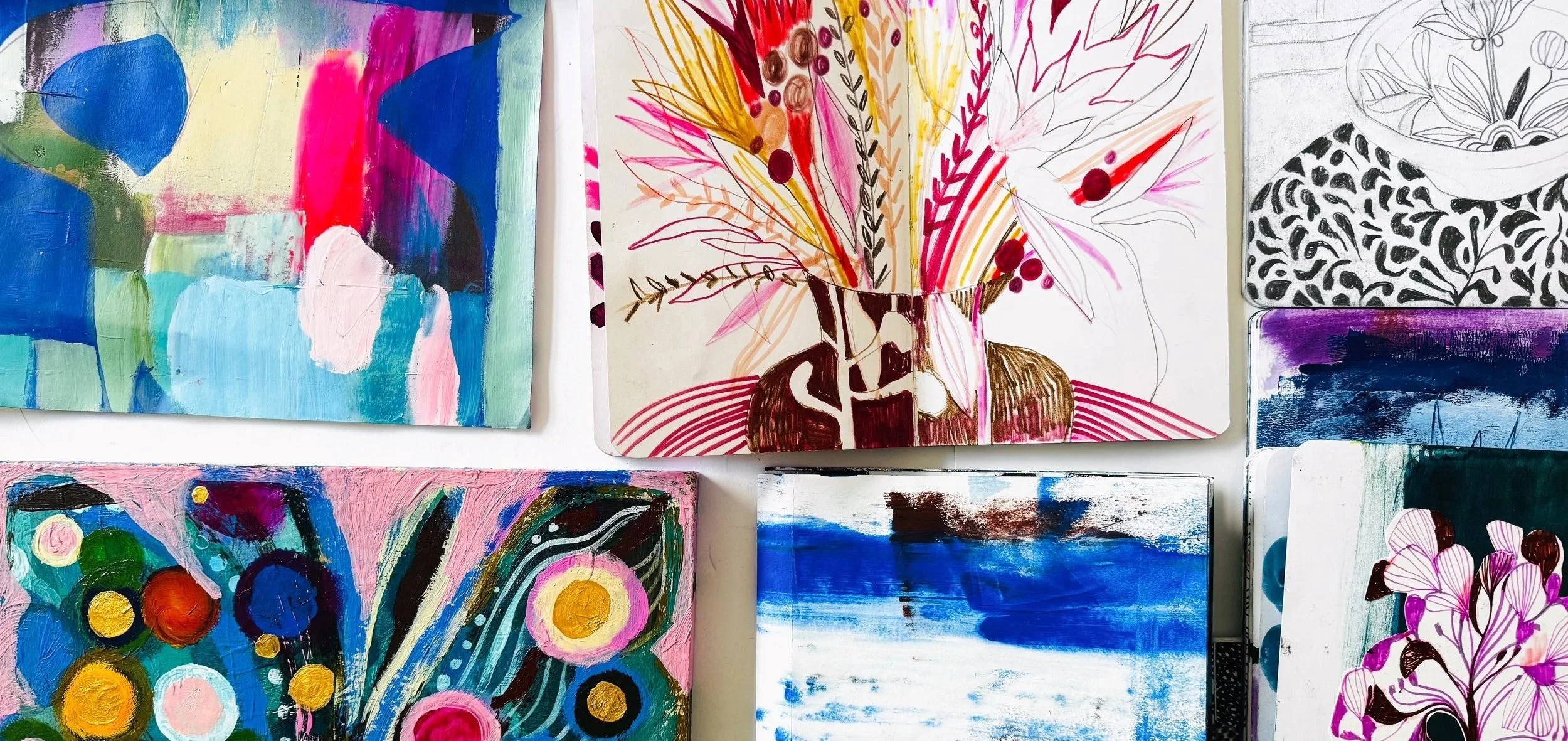
Sketchbooks are a place where I make art for myself. The pages are not necessarily filled with ‘sketches,’ the art is not necessarily a draft for something more important, although it can be, I think of my sketchbooks as a place where I experiment and express myself. Sketchbooks are where I gather together the hints, whispers and clues of my artistic practice. Sketchbooks are the filing cabinets for my art making. They are a place to collect and curate small delights and large curiosities. They are a place to make for the joy of creating, a place to find a path through, problem solve, follow a thread. They are both a homecoming and an adventure…

FILLING UP A SKETCHBOOK

I used to abandon sketchbooks after a few pages. Now I try to always fill them up, I’ve found that the more art is in a book the more inspiring I find it to work in, it gains a momentum, I often prefer what I’ve made in the second half of the book. There is something about a full sketchbook that gives me pride, the fact I am able to keep going and fill one up, it feels like an achievement.

I still find the first few pages of a sketchbook to be a little daunting though, sometimes I don’t even start on the first page, but rather I start a few pages in and circle back to fill in those first few pages when the sketchbook has found its footing…and I’m feeling more assured.

MY FAVOURITE TYPES OF SKETCHBOOK

Here are the types of sketchbook I use the most, these are just my personal preferences, the ones I like to use or buy.

1. VENEZIA BOOK FROM FABRIANO

I use different sketchbooks for different things and tend to have more than one on the go at once. For my main studio sketchbook I use a Venezia Book from Fabriano, it is my favourite. I like the paper which is 200gsm or 90lbs in weight, I use the version that is 23cm x 30 cm `which lays flat. It’s a good size for me and can take quite a lot of collage material and wet paint.

2. STILLMAN & BIRN ZETA RANGE

I buy the square version of this sketchbook which has beautiful smooth 270gsm paper and is 19cm x 19cm.

3. POCKET SIZE CONCERTINA SKETCHBOOK FROM SEAWHITE OF BRIGHTON

This is an accordion or concertina sketchbook made from long folded pieces of paper. These are small, portable and quick to fill as they are only 17.5cm x 9cm. The paper isn’t that thick but because the book is constructed from two long sheets of paper joined together it feels thicker than its 140gsm paper weight. It comes with a hard carrying case and I find it great for working outside or carrying about in my bag. It has two long pieces of paper, folded into pages and I enjoy working across these expanded surfaces and folding the pages in and out to see what I have created with new eyes.

4.DALER ROWNEY A3 ARTIST’S HARD BACK SKETCHBOOK

These hard backed sketchbooks are really large, it’s an A3 size which means a double page spread is A2. The paper is smooth acid free 160gsm and it contains 48 sheets or 48 double page spreads.

5. HANDMADE AND HOMEMADE ART BOOKS

As part of my overall sketchbook practice I love making all sorts of quick handmade, small art books and sketchbooks. I often make them from offcuts and oddments and abandoned and unloved pages and scrap paper and they become something new and interesting. To me a small homespun sketchbook feels quite liberating and joyful to create in. The stakes are low and so I perhaps create with less weight of expectation and more experimentation…


Read More

Artist research: questions and answers

Artist Research Page. Some questions and answers about my process and inspirations

I am lucky and honoured to get lots of questions from students so here is an artist research page to help answer some questions.

Describe your work:

My artwork is sometimes intuitive and intricate and sometimes bold and colourful. It often features motifs from nature or the world around me. I use expressive mark making to create abstract pieces which feature repetition and rhythm, layers of complexity and organic forms. I’m fascinated by the interplay of colours, shapes and patterns. My paintings are rarely envisioned but develop over days as I respond to the materials and the marks on the page, creating complex layer pieces full of colour and detail.

What are you inspired by?

I’m mesmerized by the beauty, colour and pattern in the natural world and in the world around me. I’ll frequently have a love affair with something where I become obsessed with it for a while; from snow flake structures, to patterns on shells, or the colours and patterns on fish scales, or antique Indian textiles, or bird feathers or butterfly wings, or the patterns on maps… I also have some magpie tendencies and am rather drawn to the glittering and glinting, iridescent or luminous… I try and seek inspiration everywhere - I will go out and walk in nature or around my home with my camera - seeking small details and interesting patterns and shapes.

What processes do you use to create your art?

I experiment in my sketchbooks and will sometimes take a seed of an idea from these and use it as a springboard for a larger work or series of work. My sketchbooks are the foundation of my artistic practice, they are where I try things out, experiment and reflect on my curiosities and fascinations.

My sketchbooks allow me to gather themes and fragments of ideas that I may want to explore more, I can look back on my sketchbooks and see whispers of ideas forming and recurring motifs and fascinations emerging. I rarely copy something from my sketchbook into a larger piece, but my sketchbook is where ideas, motifs, art material mixes ‘develop’ and then these recurring themes turn up in my paintings. I don’t ever really plan out a painting, I have a tiny starting part, a colour or a shape or a detail and I begin and respond to what emerges.

How did you develop your art style?

We all have a unique way of seeing and interpreting the world and our art is a reflection on this. My style developed from making lots of art, reflecting on the art I had made and getting curious about the aspects of it that excited me… and doing more of that. I believe my art style is always evolving and developing, it isn’t a landing spot, it’s a conversation that continues and evolves.

When did you know you wanted to be an artist?

As a child, I was always drawing. I loved spending hours creating elaborate and intricate patterns from my imagination. I used to get through so much paper that my dad started to buy me large rolls of wallpaper lining-paper to keep up with my insatiable demand for more paper. I used to have a large box in which I collected shiny and patterned papers, from sweet wrappers, pages torn from magazines, bits of shiny wrapping paper. I loved my “special paper” box, I used to like tipping it on the floor and seeing how the different patterns and colours combined with each other. So, drawing and painting was something which came innately to me as a child. But I only became a full-time artist later in life. I took a rather circuitous route to get here as a profession and it is perhaps all the sweeter for it.

Why do you make art?

* It’s fulfilling to make something from nothing

* When I’m in flow it can be meditative and absorbing to work with my hands

* I enjoy the problem solving, overcoming the obstacles, the satisfaction from keeping going when something isn’t working and finding a way to resolve it in some way

* It helps me to see the world with new and curious eyes, it brings more wonder and awe into my life

* I relish the sensory pleasure, the materials, the tactile nature of art supplies and paper

* It brings joy, colour and pattern into my life

* It helps me to respond to and interpret my interior world and the world around me

* I notice more, pay more attention to details and become more fascinated by random and unexpected beauty

* I uncover, discover and explore my interests and come up with new ones

* I enjoy the learning and the development, trying new things, exploring new techniques, the sense of possibility

* It is a way to find myself, express myself and be myself

* It feels nourishing and good for my soul and wellbeing

* Art making helps me to connect to myself and the world around me

* It is a way to understand who I am and what I am interested in. My art is my response to being in the world. It is an ongoing conversation with myself which unfurls and develops…

Where do you work?

I am very lucky to have two rooms at the top of our house in Hastings. I’ve painted the walls and floor white to maximize the light. Having painted wooden floors also means I can roll back the rugs and make a real mess without any worries. I love rugs and have them everywhere, bright bursts of colour and pattern that sing to me. So, although the walls and floor of my space are white, the space is far from minimalist.

I love collecting weird and wonderful objects and picking up old or unusual objects in junk shops. My place is scattered with old tins, patterned ceramics, pebbles from the beach, old books and interesting textiles.

The house is half way up a hill, so one of the rooms has an amazing view of the town and sky. I just love this view and find the ever changing colours and patterns of the clouds a great inspiration. Having two rooms, means I can move around depending on the time of day – leave artworks to dry, whilst packing others.

Where do you seek inspiration?

Sometimes being an artist is like being a visual adventurer. I am always on the lookout for colours, patterns, tiny inspirations that I can collect, expand upon and use in my paintings. Sometimes these come through active searching, I might take a walk on the beach or in nature to actively seek-out some inspiration, looking at the details of plants and the shapes of the leaves, patterns on pebbles, or the way the water creates lines in the sand.

What art materials do you use?

I love to mix art supplies and mix mediums. I like to experiment, explore and combine different art materials to create layers of interest and variety. I am always trying out new mixes and combinations to see what resonates with me. I love watercolour with fine-liner pen. Acrylic paint with photocopies. White ink pen over black ink. I enjoy using unexpected art making tools such as twigs or pieces of discarded ephemera.

When and where were you born?

I was born in London in 1975.

Read More

The power of creativity

Some thought on creativity….

I believe that the more creativity we can incorporate into our day-to-day lives the more fulfilling, interesting and meaningful our lives become. Here, I share a few of my thoughts on everyday creativity.

What is creativity

Creativity is making things. Creativity is breaking out of a rut. Creativity is doing things differently. Seeing things from a different perspective. It’s inventiveness, playfulness and experimentation. My idea of what constitutes creativity and your idea will be completely different and that is part of the magic. Creativity is personal and is an expression of self.

Why is creativity important

For many years I didn’t do anything creative at all – and that makes me sad. I now know that being creative brings pleasure, fulfilment and meaning. Creativity carries with it a sense of possibility and optimism. Creativity is a form of self-expression; it allows us to have a conversation with ourselves about our fascinations and curiosities. Creating things allows our head, heart and hands to work in unison.

Untapped creativity

Being creative can bring joy, delight and light. But if you’re not using your innate creativity it’s not just a missed opportunity, it has consequences. Brene Brown writes powerfully about what happens to our untapped creativity: 

Unused creativity is not benign. It metastasizes. It turns in to grief, rage, judgment, sorrow, and shame.

— BRENE BROWN

I like to challenge myself to be creative in small ways. 

Doing things differently

I like to think about how I can do things differently, or in a new way to disrupt the hum-drum a little. So, whether its walking a different way, putting an outfit together differently, cooking a new recipe, seeking an unusual ingredient, going to places I’ve never been to before, reading up about a subject which I know very little about, I’m an artist so I might read about an artist I don’t know much about, I might try using an art material or a way of making I’ve not tried before……I invite you to disrupt your habitual patterns just a little by challenging yourself to try new things or do things in different ways..

Looking and finding

I go out looking for inspiration, actively seeking new or interesting sights and places, finding and consciously absorbing details more closely than before. I like to take note and photograph things which surprise and delight me, things which I find beautiful or intriguing. Sometimes I just go for a walk wth my camera phone to find visually pleasing details, new angles and perspectives around my neighbourhood. Try it for yourself so what you can find when you pay close attention.

A stolen window of time

I love the idea from Julia Cameron of an artist’s date. This is where you set a creativity date with yourself and you do something nourishing, a stolen window of time to spend on your own, doing something ‘enchanting’, creative and fun for yourself and by yourself.

Making a list

Documenting ideas, capturing and curating them can be powerful. I like to write down all of the ways in which I could challenge myself, do things differently, things I’d like to try, things I enjoy, a running list to remind me and nudge me. I might include materials I want to explore further, artists I want to read more about…. I find that writing these things down helps to keep them alive and prevents them from getting lost to the ether… this list can be a useful route map for those days when inspiration is lacking…

So that’s just a few thoughts on creativity. I wish you lots of luck in all your creative pursuits and endeavours. Creating things for the sake of creating things can be a magical thing to do…

Read More