Art making ideasi
Ideas. Inspiration. A little creative mischief.
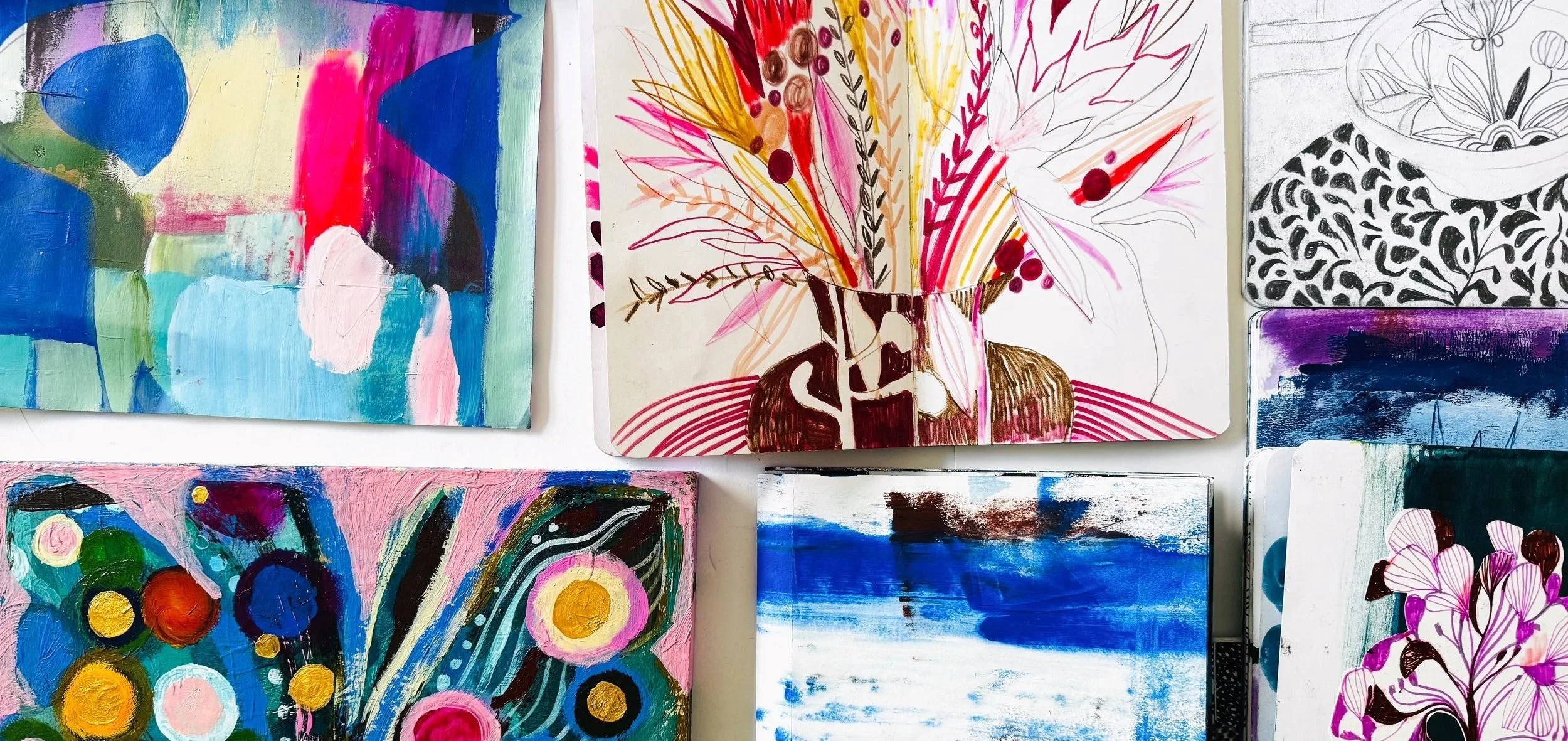
If you’re drawn to abstract and semi-abstract art, sketchbooks, colour and a little creative mischief, this is your corner of the internet.
Here you’ll find stories, videos, inspiration, art making advice and gentle nudges to help you create art that feels exciting to you.
Art inspiration is everywhere…
Slowing down enough to notice…
Music credit: Supine, Peter Sandberg
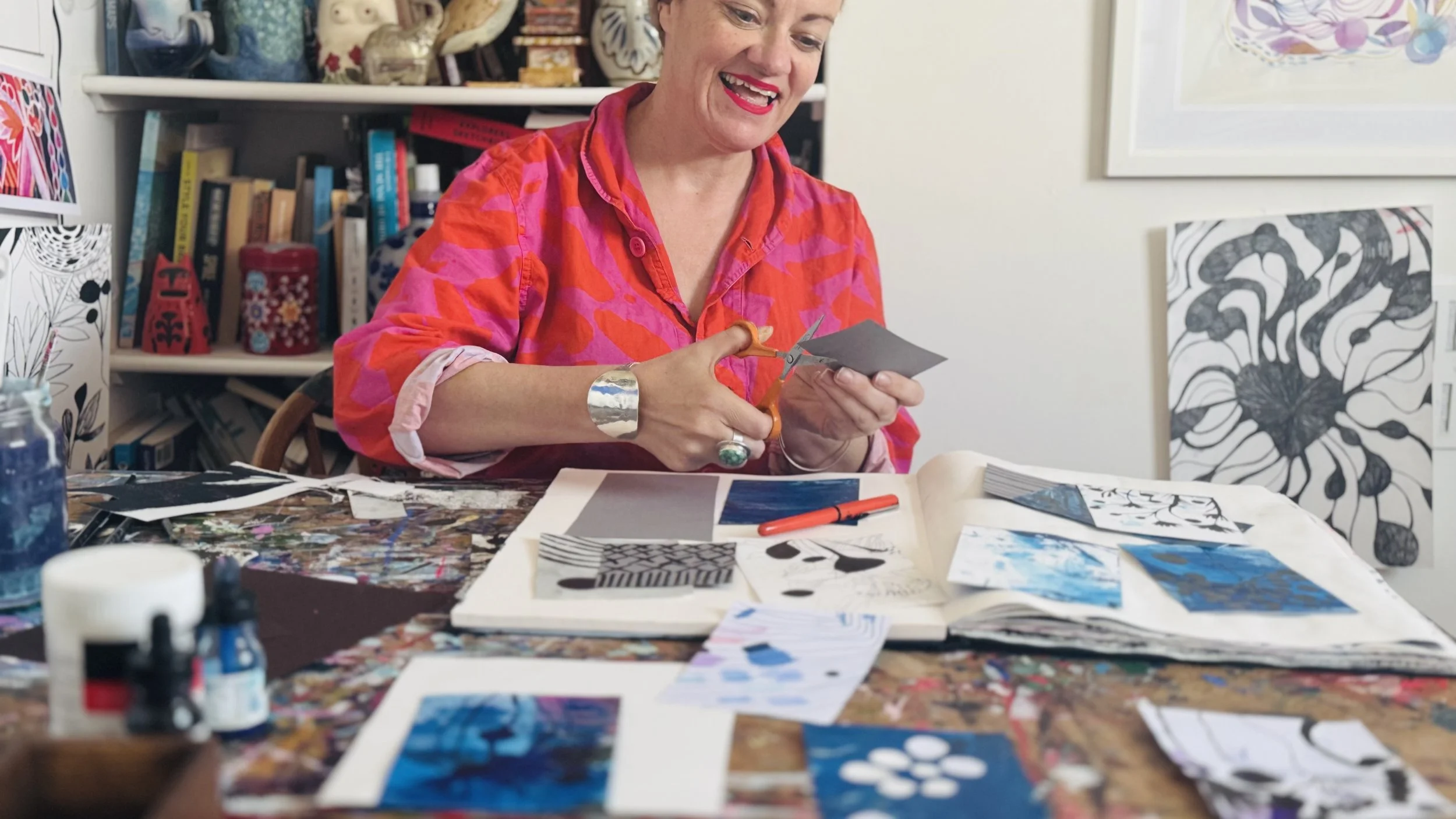
This week, I walked to the train station. Nothing remarkable. Just the usual fifteen-minute route through the centre of town. But instead of rushing I slowed down. On purpose.
I set myself a small task: Notice what catches your eye. Not the big, obvious things, but the tiny, hidden interesting shapes and patterns, motifs and moments.
I paid attention to the shadows cast by railings. The silhouette of a plants against a clear sky. Stripes of fencing, angular and imperfect.
Noticing became a kind of tuning fork, helping me tune back into my own visual sensitivities. That part of me that’s sensitive to shape and pattern. Line and contrast. Colour and texture.
I paused often.
Not to capture the perfect photo, to simply notice. And as I looked, I found more.
More shapes. More visual whispers that I’d perhaps normally pass by.
It reminded me that inspiration doesn’t shout. It waits for us to seek it out, to pay close attention, to slow down enough to notice it…
This kind of wandering and wondering is one of the easiest creative practices I know. A way to gather and reflect. Because inspiration doesn’t always come from grand views or planned studio time.
Sometimes it starts in the space between errands, on a Friday morning. Walking through the centre of town, looking and really seeing.
If you try it, you might be surprised by what reveals itself.
Materials
Here are some of the materials I was using in this video:
The paper I am using is mostly Academia Paper from Fabriano
The large A3 sketchbook is from a British brand called Daler Rowney
The small sketchbook is a Venezia Book from Fabriano
The black brush pen I am using is a Pentel pen similar to this one
The glue I am using was Liquitex Matt Gel Medium
(Some of these links are affiliate links, if you buy something through them, I might earn a small commission, at no extra cost to you. I only ever share the products that I actually use. )
Recommended Reads:
Creative compost and joining the dots…
A few thoughts on what my sketchbooks are really for…
Music credit: Stepping Stones, Laura Platt
Creative compost
Sometimes people ask me how I copy my sketchbook pages into paintings. The answer is I don’t…
I don’t think of my sketchbook as a precursor, a rough draft, or a plan to follow.
It’s more like creative compost.
Slow growing sparks
Sketchbooks are the place where ideas are scattered, layered, scribbled, left to percolate.
Some grow slowly. Some never go anywhere. Some spark something else entirely.
I come back to pages from years ago that have been quietly waiting for me, I spot something and and think “yes, this”…
And sometimes things just appear in my paintings because of artistic muscle memory, things get lodged in the artistic psyche, embedded into the visual venacular because they were once explored and unpacked in a sketchbook.
A sketchbook can be the compost and soil where ideas take root, the archive where ideas rest or the workbench where they’re shaped.
Trust the dots will connect
Nothing is wasted, everything feeds everything…
I like this idea from Apple’s founder Steve Jobs, he’s talking about life, it also applies perfectly to sketchbooks and art:
“You can’t connect the dots looking forward; you can only connect them looking backwards. So you have to trust that the dots will somehow connect in your future. You have to trust in something, your gut, destiny, life, karma, whatever. This approach has never let me down, and it has made all the difference in my life.”
~ Steve Jobs, Stanford Commencement Speech 2005
‘Trust that things will somehow connect in the future’ seems like a great philosophy for art making.
My sketchbook isn’t where I plan a painting, it is more like the soil, the compost, the place from which everything grows, the place from which all the dots eventually connect…maybe.
Art supplies
The sketchbooks I am using in this video is the Venezia Book from Fabriano.
The heavy body paint is called Sennelier Abstract Innovative Acrylic Paint
(Some of these links are affiliate links, if you buy something through them, I might earn a small commission, at no extra cost to you. I only ever share the products that I use. )
Over and over. Again and again.
Repetition isn’t always boring…
Repetition isn’t boring. Returning to the same subject, again and again can be illuminating.
It’s not unoriginal. It’s a way of noticing, paying attention, discovering.
A way of building muscle memory, of distilling what you love.
Each return becomes an ongoing creative conversation. Not a rut, more like a rhythm.
A variation on a theme as old as art-making itself.
You don’t always need something new.
Sometimes you just need to stay. To linger. To return.
To pay closer attention to what already lights you up.
That’s how you learn about yourself as an artist. Again and again. Over and over…
P.S. These sketchbook pages grew out of an idea I teach inside Sketchbook Magic: Experimenting with Colour & Pattern If you’d like to try it too, the class is always open, always available for £20.
Joy as a compass…
Thoughts on finding a style and leaning in to what you love…
I used to think I had to “find my style.” Pick a lane. Pick a niche. Pick a version of myself that made sense on the internet.
But the more I tried to choose...the less like me it all felt. So I stopped chasing a style. And I started following joy.
The delight of a scribbled mark.
Colour combinations that made my heart sing.
The lines that happen when you’re not overthinking, when you’re not trying too hard. And after years of this, I can tell you: You don’t have to find your style. If you follow what feels good, it’ll find you.
You don’t have to find your style. If you follow what feels good, it’ll find you.
Because joy isn’t just a feeling or a byproduct of art making. It’s the compass. The method. The map that leads you home within your own your art.
Paying attention to all the things you love in your own art is the best way I know to make art that feels good and that embodies your style…
P.S. Joy Filled Flowers is a self-paced sketchbook class that helps you loosen up, experiment with mixed media, and bring joy back into your creative process and sketchbook practice. Online. On-demand. £58
From bold colour to black and white.
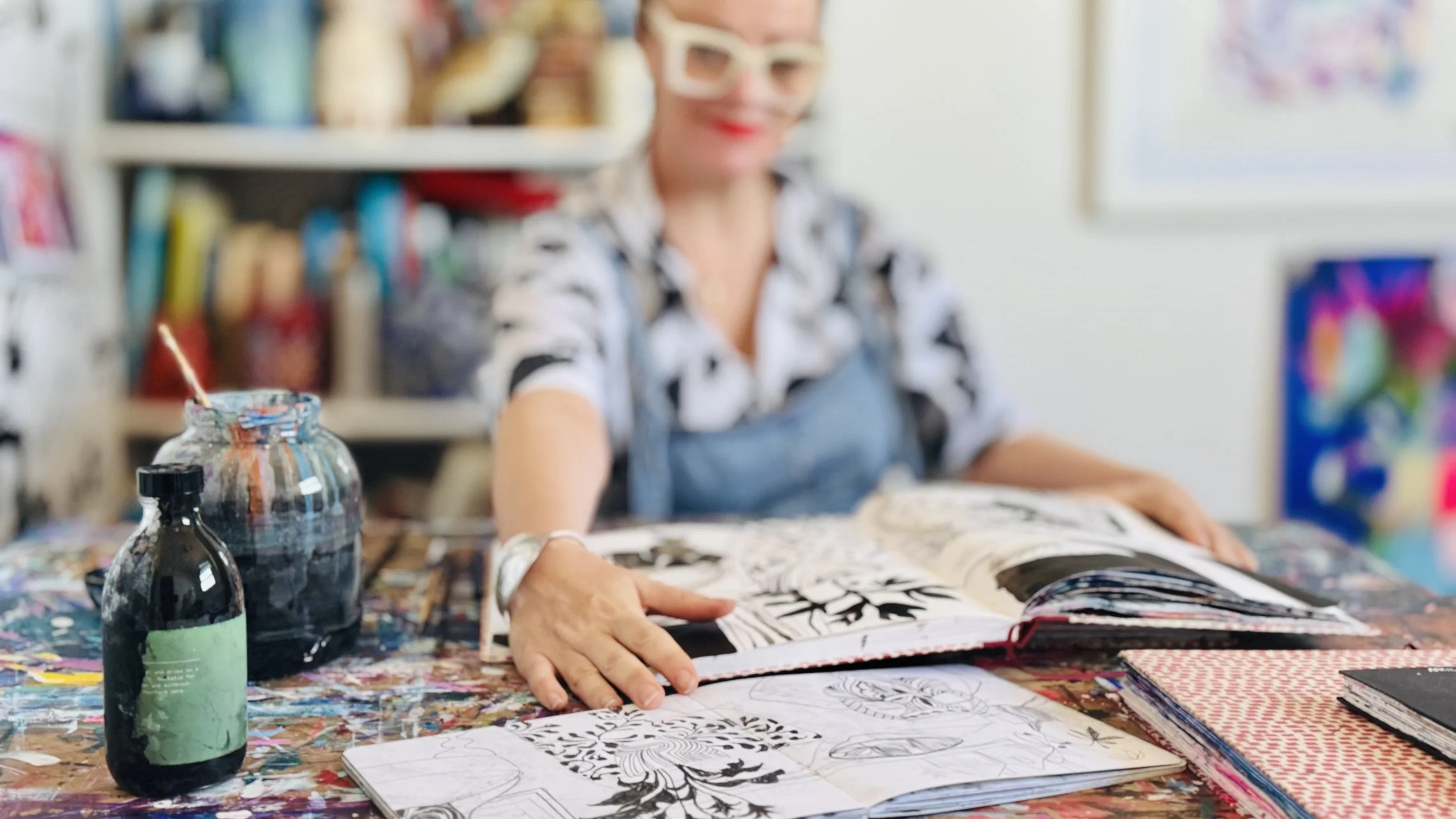
I’ve just finished some colourful paintings. But in my sketchbook things are black and white…
Music credit: Beauty in the Mundane by Bird of Figment
I’ve just finished some colourful paintings. But in my sketchbook things are black and white.
Original acrylic painting on cradled wooden panel
30 x 30 x 4 cm (approx. 11.8 x 11.8 inches)
A single, stylised tree stands strong in this one-of-a-kind painting. Layered with textures, delightful details, pattern and traces of hidden marks beneath the surface.
Created with multiple layers of acrylic paint, this piece holds subtle flashes of colour, quiet hints of gold, and gentle shifts in light. My hope is it is that it captures a moment paused somewhere between dream and memory.
This painting invites a sense of magic, wonder, and quiet intrigue. When I was painting it I was thinking that I wanted it to feel like a treasured object that seems to hum with its own magical story.
Original acrylic painting on cradled wooden panel
30 x 30 x 4 cm (approx. 11.8 x 11.8 inches)
A single, stylised tree stands strong in this one-of-a-kind painting. Layered with soft textures, delicate details, and traces of hidden marks beneath the surface.
Created with multiple layers of acrylic paint, this piece holds subtle flashes of colour, quiet hints of gold, and gentle shifts in light. My hope is it is that it captures a moment paused somewhere between dream and memory.
This painting invites a sense of stillness, wonder, and quiet presence. When I was painting it I was thinking that I wanted it to feel like a treasured object that seems to hum with its own magical story.
There’s a kind of ease I find in black and white. A clarity. A calmness. A confidence.
Colour is beautiful, but it asks for a lot of decisions. Black and white strips that away.
No second-guessing shades. No hunting for the perfect combination. That’s why I often return to monochrome as a sketchbook practice. Just simple tools and simple choices.
It lets me get going and keep going.
Simple and strong
It’s not plain. It’s powerful. High contrast. Strong composition. Every mark holds more presence and fewer choices mean more flow.
Working in black and white helps me focus more on composition, the shapes, the balance, the space between things. There’s a simplicity to it that I find really pleasing.
Fewer choices. More momentum.
When the palette is limited, I notice different things: The weight of a line. The balance of space. The relationship between forms.
Composition becomes clearer. Decisions come faster. There’s less second-guessing. More doing.
Why it works (especially when life feels full)
Because simplicity quietens the noise. Because constraints build momentum. Because joy often lives in the simplest things.
Black and white invites you to notice more, not less. To pare back. To pay attention. To create without pressure.
And sometimes it just feels very satisfying.
Try this:
Next time you feel stuck, try removing colour from the equation. Pick up one pen, one pencil, one sheet and begin. You might be surprised by how powerful simple can feel.
Books mentioned in video
How Painting Happens and Why is Matters by Martin Gayford, published by Thanes and Hudson, 2024
Barbara Rae Monograph, published by The Royal Academy 2025
Links to artist mentioned in video
Materials and art supplies mentioned in video
I purchase a lot of my pens, pencils and inks from an independent British shop called Cult Pens it has a phenomenal range and great customer service.
It has a refer a friend programme, so if you use this link to purchase you can get 10% off your first purchase and I get a 10% discount off my next purchase too. Or here are the direct links with no discount:
Sailor Fude de Mannen Calligraphy Fountain Pen
Sketchbook
The sketchbook I am using in this video is the Venezia Book from Fabriano.
(This is an affiliate link, if you buy something through this, I might earn a small commission, at no extra cost to you.)
PS: My self-paced online art classes are here to support possibility and play, with lessons built around exploration, composition, and the unexpected details that make your work feel truly yours. No pressure. Just quiet encouragement, creative rhythm, and joyful exploration. Start anytime. Come back often. Make more art..
Tired and uninspired? Borrow my sketchbook ritual
You don’t have to wait to feel inspired to make art.
When I’m tired, under-inspired, or my mojo feels a little so-so, I don’t reach for brilliance. I try not to expect too much of myself. I reach for my sketchbook, a place to meander, freewheel, and gently find my way back to creativity.
No pressure. No performance. Just low-stakes creating. I don’t perfect. I don’t polish. I don’t pretend. I open my sketchbook. Not like it’s an art gallery, but a playground. Its pages aren’t for applause or approval. They’re a route back to delight. A sketchbook isn’t the stage. It’s the backstage.
My gentle rituals
Here’s what helps when I need to soften the edges of perfectionism:
1. Start easy
Look for the simplest way in. Often I’ll dig out something I’ve already made and use it like a guide rope into something new. When the goal is simply to begin, familiarity becomes fuel.Reassuring. Cosy. Comforting.
2. Limit supplies
Less choice. Less decisions. More play.
In this video I just use a little Indian ink from Jackson’s art and one Derwent Inktense pencil in my Fabriano Sketchbook. The large brush I am using is a pointed mop brush
Ps. These are affiliate links to products I use myself and genuinely enjoy in my own sketchbook practice. Thank you for supporting me if you choose to use them.
3. Narrow the palette
Constraints aren’t a cage. They free you from the overwhelm of too many options.
4. Set a short timeframe
Give yourself a short timeframe. Long enough to soften resistance. Short enough to slip past perfectionism.
5. Add surprise
Something playful. Unexpected. A strange mix of materials. A new way to hold the brush. A weird tool. Surprise isn’t just fun it leads to discovery.
Inspiration arrives quietly
Inspiration doesn’t arrive on command. It tiptoes in through low expectations and inky hands. A sketchbook isn’t about getting it right. It’s about finding your way back to flow. Back to energy. Back to the part of you that creates simply because it feels good to create. It’s where the mess is allowed. I like the idea of joy wearing joggers. Joy returns in those relaxed moments when we’re not forcing or performing, or chasing some false idea of what "good" looks like.
Because good looks like doing something. Anything at all.
A sketchbook isn’t a stage. It’s a place of freedom.
So next time you feel tired or uninspired, don’t reach for brilliance.
Reach for the simplest starting point.
Reach for the messy lines.
Reach for the small thing may bring you joy.
P.S. Want more supportive creative guidance? Explore my self-paced classes here, full of joyful, no-pressure lessons to nurture your art practice.