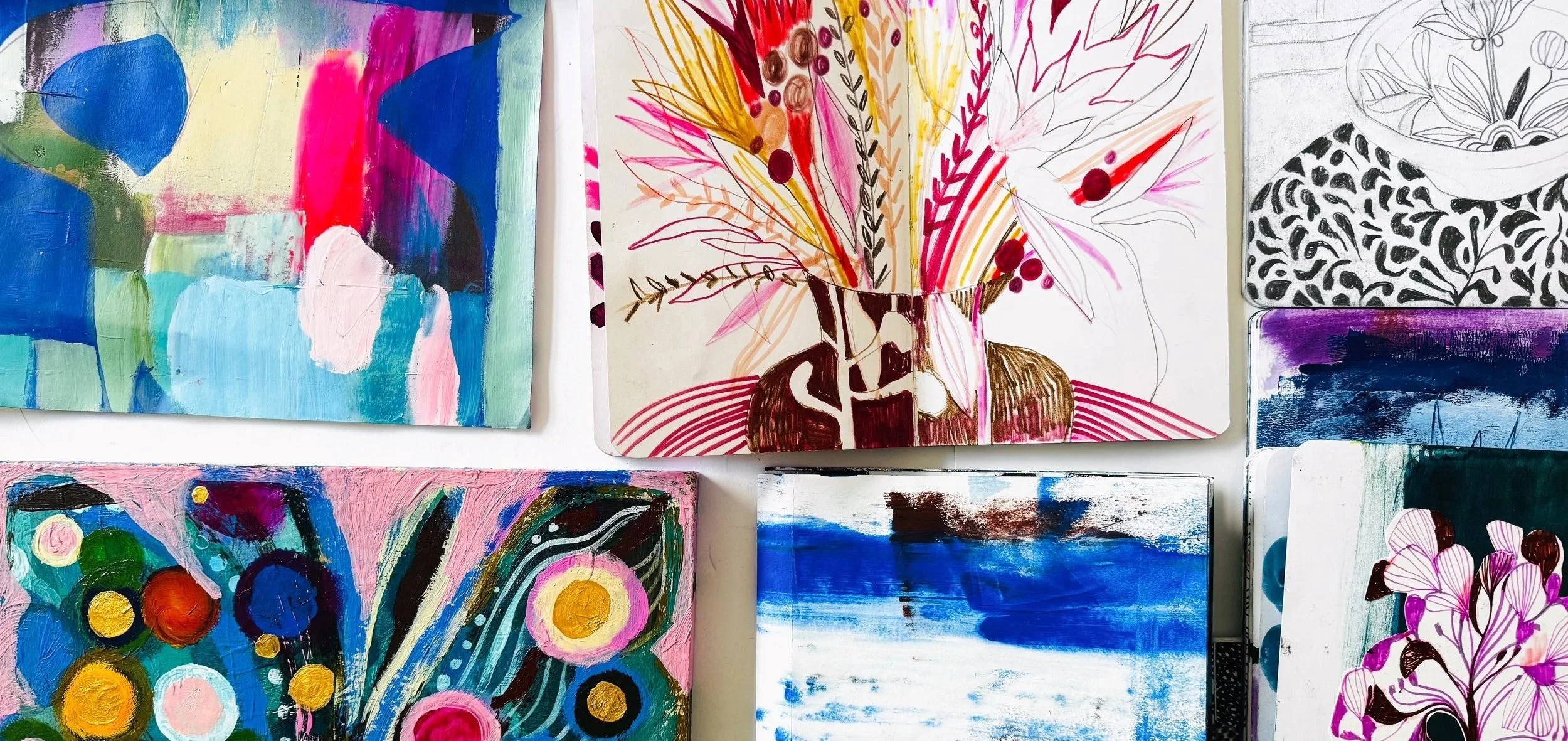
Art making ideasi

Ideas. Inspiration. A little creative mischief.

If you’re drawn to abstract and semi-abstract art, sketchbooks, colour and a little creative mischief, this is your corner of the internet.

Here you’ll find stories, videos, inspiration, art making advice and gentle nudges to help you create art that feels exciting to you.

Joy as a compass…

Thoughts on finding a style and leaning in to what you love…

I used to think I had to “find my style.” Pick a lane. Pick a niche. Pick a version of myself that made sense on the internet.

But the more I tried to choose...the less like me it all felt. So I stopped chasing a style. And I started following joy.

The delight of a scribbled mark.

Colour combinations that made my heart sing.

The lines that happen when you’re not overthinking, when you’re not trying too hard. And after years of this, I can tell you: You don’t have to find your style. If you follow what feels good, it’ll find you.

You don’t have to find your style. If you follow what feels good, it’ll find you.

Because joy isn’t just a feeling or a byproduct of art making. It’s the compass. The method. The map that leads you home within your own your art.

Paying attention to all the things you love in your own art is the best way I know to make art that feels good and that embodies your style…

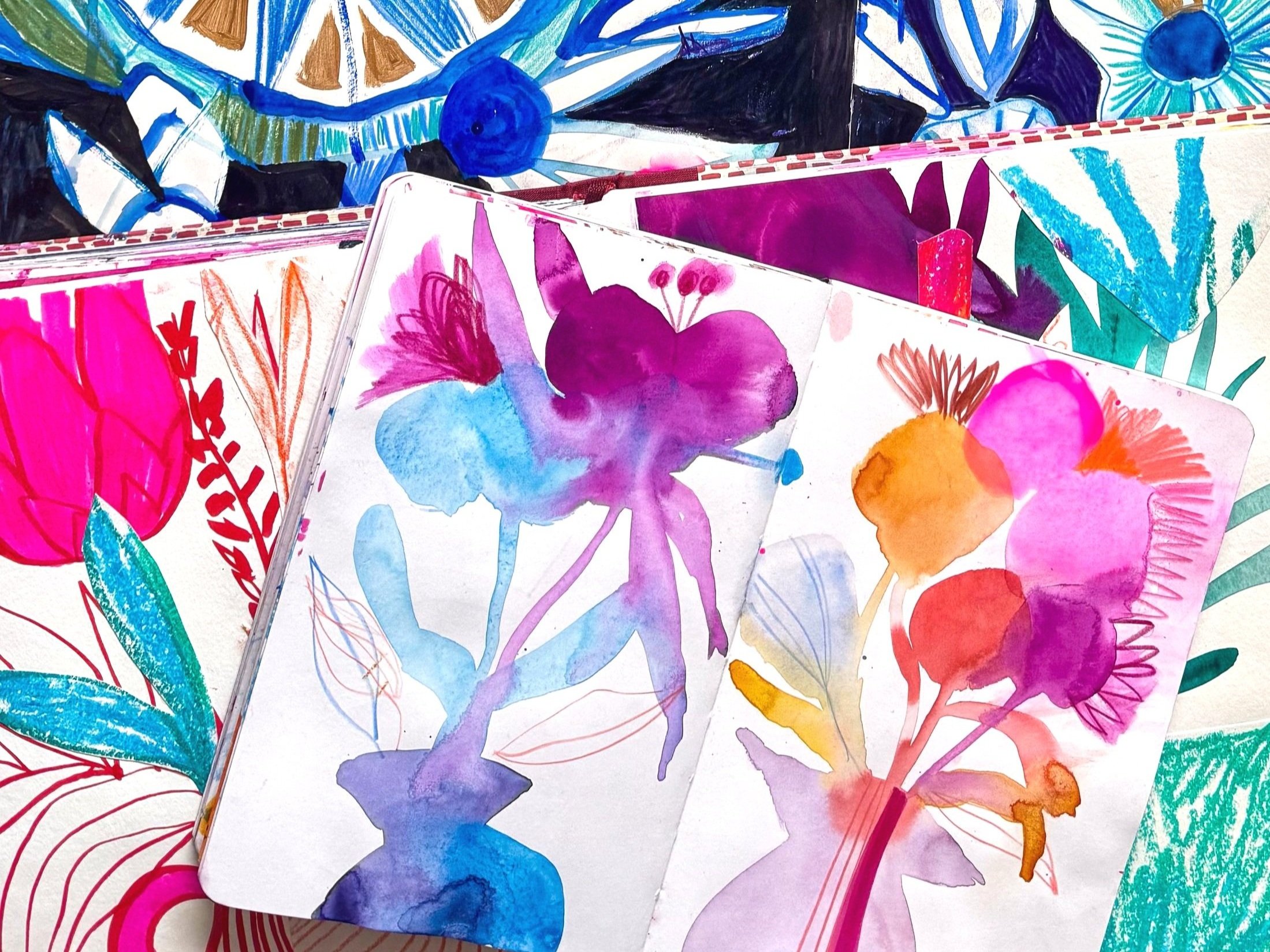
P.S. Joy Filled Flowers is a self-paced sketchbook class that helps you loosen up, experiment with mixed media, and bring joy back into your creative process and sketchbook practice. Online. On-demand. £58

Read More

Layering ideas

Thoughts on developing new ideas, sketchbooks and handmade sketchbooks made of old papers…

There’s something magical about flipping back through old sketchbooks. The pages are a container for our past ideas, experiments, and creative selves, some ideas are fully realised, others are only partially explored and developed.

What if these pages contained the sign posts to something entirely new?

Small sketchbooks made from scraps and abandoned pages

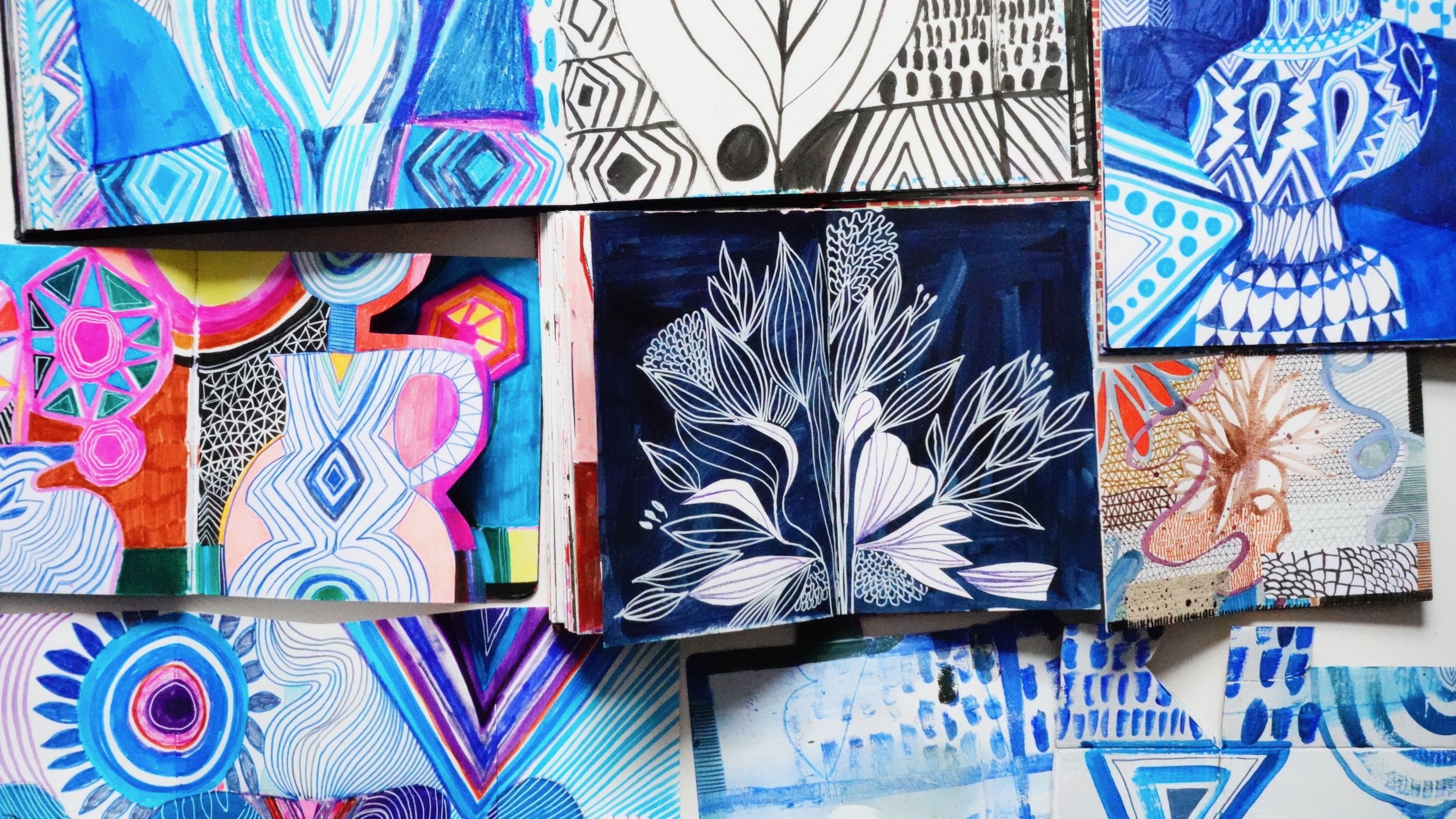
One of my favourite creative exercises is revisiting old sketchbooks and creations and weaving together different ideas, techniques, and themes to create something new. Layering together ideas as a way of honouring past explorations while pushing into new territory.

If you’re feeling stuck, uninspired, or just curious to see where your work can go, you may like to try this for yourself.

Gather and reflect

Start by pulling out a few of your older sketchbooks or art works, especially the ones you haven’t looked at in a while. Consider your work without judgment. Instead of critiquing, observe with curiosity. What stands out? Are there patterns, motifs, or color combinations that still excite you? Maybe there’s an old idea or composition that didn’t quite work at the time but feels full of potential now.

Hunting for clues

Look for ideas to pick and mix, mix and match. Are there any sketches, techniques, or themes that you could combine together that perhaps you wouldn’t normally put together. Maybe you have a page of delicate floral studies and another filled with bold, abstract mark-making. What happens if you created something new which combines these two ideas? Or perhaps there’s a color palette from one thing that could breathe new life into a completely different subject.

Try making a list of interesting pairings, that you gather from your own creations:

  • Watercolor washes + intricate pen line-work

  • Geometric collage shapes + loose gestural painting

  • Drawn details over bold botanical shapes

  • A sketch from years ago + a technique you’ve recently mastered

Pick and mix experiments

Now it’s time to play. Create a new piece or sketchbook page inspired by what you have found. Let go of expectations and approach it as an experiment. Maybe it turns into a finished piece, or maybe it’s just a stepping stone toward something else, but either way, it moves you forward.

Here are some more suggestions of ways to mix things up:

  • Redraw an old sketch using a completely different medium

  • Redraw an old sketch using a completely different set of colours

  • Take a tiny detail from an old sketch and scale it up into a full composition.

  • Concept stack. Take three completely different ideas from different sketchbook pages, or previous creations and combine them into something new.

Let it evolve

Creativity thrives on curiosity, so don’t be afraid to push the boundaries a little. What happens if you introduce an unexpected element? What if you challenge yourself to work in a size or format you’ve never tried before? Sometimes, the most exciting breakthroughs happen when we step up to and outside of, our comfort zones.

The beauty of looking back

Revisiting old work isn’t about repeating the past necessarily, it’s about mining it for lost treasure and using it as a bridge to something new.

Every sketchbook holds layers of who we were as artists at different points in time, and when we mix those layers together, we often uncover something surprising.

So, the next time you feel stuck, flip through your own work with fresh eyes. The inspiration you need might already be waiting for you in what you have already created.

Our previous work can give us a sign post to our future creations…


Read More

A love letter to sketchbooks

A love letter to sketchbooks…


There’s no one right way to do anything, and that includes keeping a sketchbook.

My sketchbooks feel like a motley gang of unruly but beloved friends, each one different, with its own quirks and oddities. And that’s exactly why I love them, not in spite of their weirdness, but because of it.

You know that saying about friends: “They come into your life for a season, a reason, or a lifetime”?

I think it applies to art-making and sketchbooks too. I look back at certain sketchbooks and remember those seasons of life so vividly, times when a sketchbook was an escape from life’s upheaval, a place of quiet creativity or times when it was simply a place of carefree art adventure.


Sketchbooks: A powerful creative tool

A sketchbook can be one of the most powerful creative tools an artist possesses.

For me, they’ve been life-changing. They’ve helped me move from hesitation to confidence, from creative uncertainty to finding my artistic voice. My sketchbooks have been a springboard into a more colorful and creative life. If you’ve ever considered keeping a sketchbook, here are a few reasons why you may like to start or re-start.


Making art for yourself

There is something deeply nourishing about making art just for yourself. Experimenting in a sketchbook can lift the spirits and bring immense joy. The simple act of transforming a blank page into something alive with meaning, color, and line is rewarding in itself. A sketchbook is a private place where we can have a creative conversation with ourselves. For me, it has been where I have learnt to be less critical and judgemental of myself and my art.

So many pages, so many opportunities, so much possibility has helped me loosen my attachment to how any one thing turns out…it just doesn’t matter.


A place to begin

Sketchbooks are where we find out about our own art sensibilities, not where we show up fully formed. They are part of the journey, not the final destination.

When we start working in a sketchbook, it helps to embrace a beginner’s mindset—to stay open, curious, and willing to explore. It’s okay to make mistakes, things that haven’t worked teach us something. We don’t need to expect too much from ourselves. I love this idea from Vincent Van Gogh:


“I am always doing what I can’t do yet, in order to learn how to do it.”


A place to learn and grow

In a world obsessed with outcomes, a sketchbook offers a space for discovery. It allows us to explore our interests, experiment with techniques, develop and flex the ways in which we make art. A sketchbook is where we learn what excites us creatively, where we test ideas, push our boundaries, refine our process, and reflect on our evolving art practice.


A place to practice

It is called an art practice for a reason, a sketchbook is a great place to practice and track the progression of an idea, skill or approach.

A filing cabinet of ideas

A sketchbook is more than just a collection of drawings—it’s a filing cabinet for your creativity. It gathers fragments of inspiration, allowing us to flip through pages and spot recurring patterns, themes, and ideas. Over time, our sketchbooks reveal what captivates us, helping us refine our artistic identity.

Begin where you are

A sketchbook is a companion, a teacher, a playground.

It doesn’t demand perfection. It invites exploration. It reminds us that creativity is not about flawless execution but about showing up, trying and growing.

So, if you’ve ever hesitated to start a sketchbook, let this be your sign: Begin.

Fill the pages with your ideas, your experiments, your mistakes, and your joy. Let it be a space where your creativity can run wild, unfurl and be unjudged.

You never know where it might take you.

Types of sketchbook

Here are some of the sketchbooks I like, but sketchbooks are a personal preference and come in so many different shapes, sizes and varieties, the sketchbook that is right for me, may not be right for you.

The best sketchbook to use is always the one you already own.

  1. The Venezia Book from Fabriano

  2. Stillman & Birn, Zeta Range

  3. The Ebony Artist Book from Daler Rowney

  4. Dylusions Creative Journal Large from Ranger

  5. Seawhite of Brighton Pocket Concertina

  6. Talens Art Creation Sketchbooks

    (Some of these links are affiliate links, if you buy something through them, I might earn a small commission, at no extra cost to you. I only ever share the products that I actually use. )

Read More

Balancing chaos and focus in art making

Here I share some thoughts on how creativity works…

Creativity often swings between inspiration gathering and disciplined execution. At the start of any creative endeavor, we might need a little chaos—openness, curiosity, and exploration. But to bring an idea to life, we need the opposite: clarity, focus, and determination.

Sometimes, we need the scattergun. Sometimes, we need the laser.

As I write this, I’m in the thick of filming my next online course. The process of creating this course has made me reflect on how creativity often demands two distinct modes: exploration and execution.

For the past two months, I’ve been in the scattergun phase—of coming up with ideas, hunting, gathering, experimenting, and throwing ideas at the wall to see what sticks. I’ve been absorbing books, discovering new artists, writing notes, journalling, sketching, expanding different techniques, and letting curiosity lead the way. This stage thrives on novelty, variety, and stimulation. It’s a time for playful chaos—inviting in fresh ideas, mixing influences, and allowing creative sparks to ignite.

But now, I’m in the laser phase—actually turning the ideas into a reality. Taking all the threads and creating the thing. This requires a completely different mindset: deep focus, structure, and an ‘all-in’ mentality. The distractions that once sparked ideas now threaten progress. Instead of jumping between concepts and tasks, I must commit, push through challenges, and sustain intense concentration.

This dance between divergence and convergence happens in most creative endeavors. It happens when making art—we start with an open field of possibilities, then gradually we define a path, make firm decisions, and commit.

Navigating the two modes in art making:

Embrace the scattergun phase fully

  • At the start of a project or new body of work, embrace the ambiguity and uncertainty. There is often a lot of ‘not knowing’.

  • Experiment with different materials, colours, techniques, styles and subjects—invite in the ‘new’ or novel without pressure or expectation.

  • Seek inspiration from unexpected sources: museums, obscure books, nature, seek outside of your usual circles of reference...

  • Fill sketchbooks with unfiltered ideas—sketchbooks are often divergent thinking in action…lots of experimentation, gathering, connecting dots…

  • Follow your intuition. Let curiosity guide you. Resist the urge to make sense of everything immediately—connections and breakthroughs often emerge over time.

  • Give yourself the opportunity to rest and the space to think if you can; creative ideas often surface when the mind is relaxed. “I’ll sleep on it”…is a truism for a reason. Allowing a little spaciousness into our lives, is fertile, it can allow ideas to take shape and grow.

  • Gather inspiration like you’re building a virtual pinboard—often, magic happens in the weird combinations and unexpected connections.

Commit to the laser phase when it’s time

  • Finishing an artwork or any creative project often requires a real focus and concentration. Align deep work with your natural energy cycles—concentration flows best when you work with your own rhythms.

  • Set aside dedicated ‘studio’ time to refine, develop, and focus on your work. Set a timer for an set period of intense concentration and deep focus

  • Trust the instincts you developed in the exploration phase—this stage is about shaping, not second-guessing.

  • Reduce distractions (social media, external input) and fully immerse yourself in the process.

“Efforts to deepen your focus will struggle if you don’t simultaneously wean your mind from a dependence on distraction.”

― Cal Newport, Deep Work

Know when to switch gears

  • If your work feels chaotic and unfocused, it might be time to narrow in and commit to a single direction.

  • If you feel stuck or uninspired, loosen up—step away, explore new references, invite in something new or experiment freely again.


Creativity in art and life isn’t about choosing one approach over the other—it’s about learning to move between wild experimentation and disciplined refinement. The scattergun fills the well; the laser brings the vision to life. It seems to me that both are essential.


Read More

Creativity can be a balm for the soul

Creativity is a balm for the soul…

A lot of people don’t feel creative because they’re physically and emotionally exhausted. The recipe for your life should be this: rest until you feel like playing, then play until you feel like resting, and then repeat.
— Martha Beck, Quoted in the Los Angeles Times 7th January 2025


2025 has unfolded slowly for me. I’ve been poorly with something resembling flu and have spent much of this new year in my pyjamas coughing …

Pencil sketchbook pages from last year


I have done little in life or art, but now I am feeling a bit stronger I have spent some low-key, quiet time meandering in my sketchbook.

Playing with some simple drawing materials… Expecting very little of myself, creating as a lovely distraction. Manufacturing small moments of joy, just as a nice thing to do. Creating for the sake of creating, not for any outcome, just for the experience of doing it.

A sketchbook from a few years ago…

It has made me think about the healing nature of creativity and how beneficial my sketchbook practice has been to me through difficult passages of life.

The last five years have presented a small rollercoaster of personal challenges, as I’m sure they have for many. I’ve had some on-going chronic health issues, my mother died after being ill for many years and we had a house flood which meant we had to re-build the bottom floors of our home whilst living in a hotel for many months… and through it all my sketchbook practice has felt like an anchor, it has been a wonderful balm for my soul and a comforting creative place to go.

Creating in my sketchbook has felt restorative, enriching and up-lifting, sometimes fun, sometimes a necessary source of calm and distraction. A small place to go and be creative. A place where I can just do a little, or sometimes a lot. Sometimes a place to rest and refuel, sometimes a place to wonder and be wild.

Previous sketchbooks


When life seems to derail our creativity, and when things happen that dampen our natural desire to create … it is perhaps in exactly these moments of life that creativity can be important.

In times of difficulty, small creative moments are perhaps more crucial, they can provide hope, light and encouragement. When we create art we are reminded of valuable lessons which are also needed for life. Our whole life is a creative act, which requires courage, problem solving, tenacity, a sense of adventure and optimism. And when we make art we remind ourselves of our ability take a blank page and make it into something meaningful.

A creative practice can be life-enriching and supportive, whatever is happening…

My sketchbook has been both a refuge and an escape. Using a sketchbook has provided a nourishing playground, a sanctuary and a safe harbour when waters have been choppy. It has been a place to ground both myself and my art.

Small handmade art journals

My sketchbook practice has been so valuable to me only because my expectations are so low.

The stakes are low. It is a place for me to create for the joy of creating, a place to create art for the sake of creating art. A place to make anything I want to make. A place where the activity is perhaps important than the outcome. Scribbling and mark making is sometimes enough.

A sketchbook is personal. Your sketchbook, your rules. It’s a place to primarily make art for yourself, to let your interests and style iterate and unfold, it’s not about displaying art, getting approval or finished and finessed works, it’s a place to work things through, figure things out and have a creative conversation with yourself. Or just to play about with materials, to colour-in, because that is what you need in that moment.

Pencil and felt tip pen sketchbook page

Whatever is happening in our lives, creativity can support us in small and large ways.

Creativity is an important way to express ourselves, connect with ourselves, understand ourselves, a way to cope, a way to find hope, a way to meditate, think, feel, process and reflect.

Ultimately making art is a way to come home to ourselves…

A pencil drawing in my sketchbook

You might like this:

Here are some other posts which you may enjoy:

Mixed Media Sketchbook Tour

The Ebbs and Flows of Creativity

Artist’s Sketchbooks

A pencil Still Life drawing

Drawing and exploring in a sketchbook

Read More

Love of Pattern

This is a love letter to pattern. Take my patterned sketchbook tour and see some art books to inspire…

My love of decoration, ornament and pattern has been a life-long love affair.

All of my very earliest childhood memories involve pattern in some way..,the wallpaper in my infant bedroom, the pattern of a dress, a carpet, a bedspread, a plate, the decoration on our neighbour’s biscuit tin when I was only three or four. I see and remember the world via pattern.

The art we make reflects who we are back to us, doesn’t it?. It can be a projection, an extension of who we are, a culmination of our experiences, our sensibilities, our curiosities, our feelings…. And my art definitely celebrates a love of pattern.

Humans are pattern makers

I think perhaps patten also has an instinctual universal appeal too. Humans are pattern makers and pattern seekers. From the earliest times we have added ornament, decoration, motifs and marks to the items in our world, we turn the ordinary into the extraordinary through making our mark on the world. .We have always added pattern, ornamentation, decoration and detail to the items in our lives to make our lives more beautiful.

Humans are pattern seekers

We seek patterns as a way to understand the world.. there is comfort, familiarity and understanding in repetition and repeats…and at it’s most basic form that’s exactly what a pattern is. It’s a shape, a motif, a mark… repeated.

I seem to agree with the saying that ‘repetition makes perfect’…

Books and links

Here are the books I share in the video.

Terry Winters. Paintings, Drawings, Prints 1994–2004 Hardcover, 2005 by Richard Shiff (Author), Rachel Teagle (Author) Published by Yale University Press.

This book is now out of print but you can see more of Terry Winter’s art on his website here

Matisse in the Studio Hardcover – 6 April 2017 by Ellen McBreen (Author) et al, Royal Academy of the Arts

Read More