Art making ideasi
Ideas. Inspiration. A little creative mischief.
If you’re drawn to abstract and semi-abstract art, sketchbooks, colour and a little creative mischief, this is your corner of the internet.
Here you’ll find stories, videos, inspiration, art making advice and gentle nudges to help you create art that feels exciting to you.
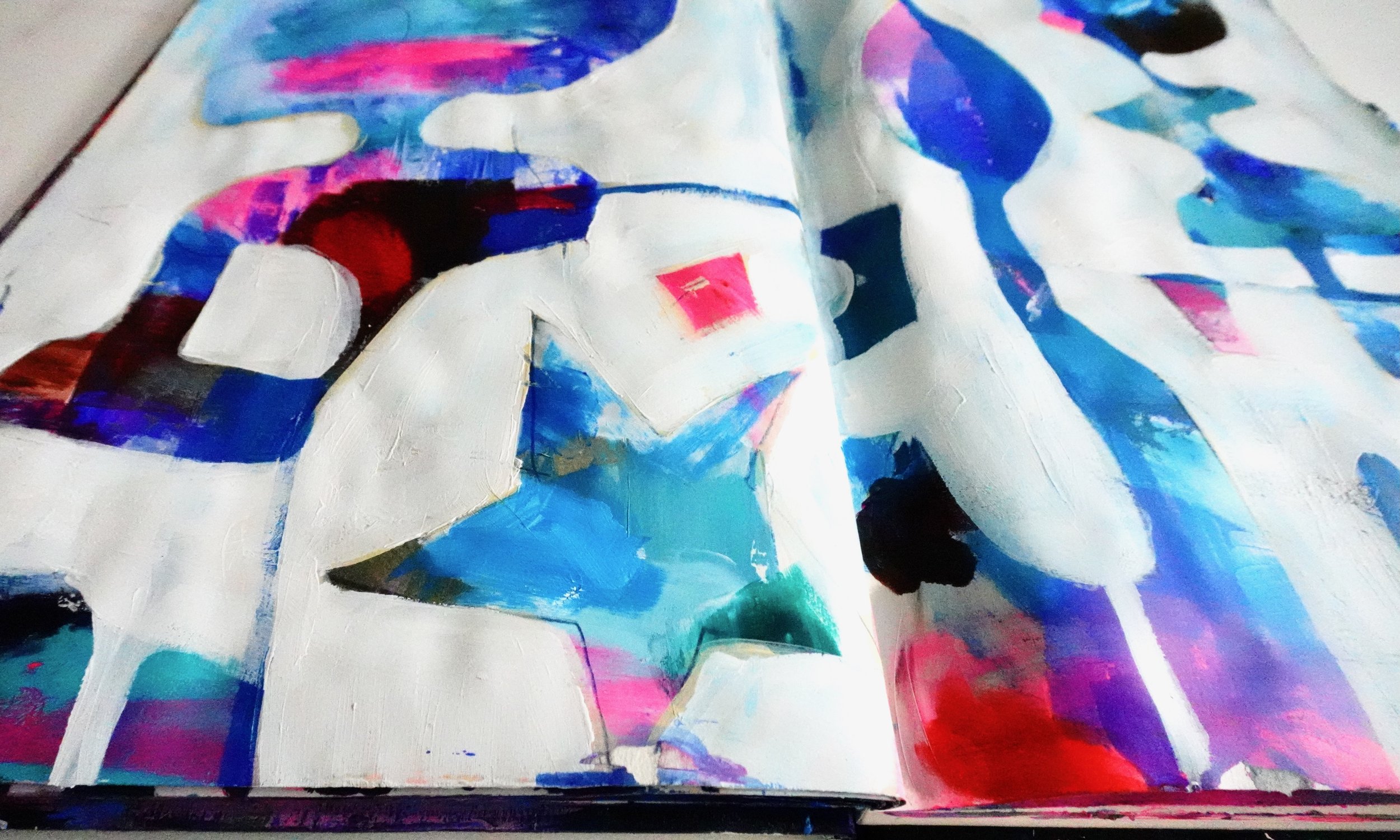
Art demo: abstract painting inspired by shapes
A practical tutorial about painting abstract pages inspired by shapes…
Music Credit: Supine by Peter Sandberg via Epidemic Music.
In today’s video I demonstrate a way to build up an abstract painting using layers of acrylic paint and shapes. I take some of the shapes from a previous drawing exercise and use them to develop striking abstract painted pages in a sketchbook.
In this painting demonstration I am using heavy body acrylic paint from Sennelier in a Daler Rowney A3 Sketchbook which has 160gsm paper.
This paint has quite a matte finish (although I think it is technically described as satin) so it doesn’t tend to result in sketchbook pages which stick together, some heavy body paint can be quite glossy and it is this shine that results in finished pages sticking together, despite them being dry when you close your sketchbook.
This demo and exercise is messy and playful and it can create interesting and surprising results…(if you enjoy a pristine sketchbook or are at all concerned that the paint you are using might possibly cause your pages to stick together you may want to try this on a piece of paper instead). I hope you enjoy it.
Online art classes
Painting: a process of discovery
Painting is often like setting off on an adventure with no idea of the destination
In this video I chat about how painting can sometimes feel like setting off on a trip with no idea of the destination. When I start painting I can’t always predict the direction the paintings will take. The act of painting can feel like an adventure to an unknown land.
No idea how they will develop…
I’m currently working on a series of new paintings, developing several at once, edging them all forward slowly. Sometimes I enjoy the challenge of a destination which is totally unknown to me, of taking a blank surface and turning it into something alive with paint and colour and pattern… When I started these paintings I had no idea how they were going to develop or what they were going to become. They’re not yet finished, they are still becoming.
Sense of discovery
Sometimes when I create, I have a clear end result in mind, clarity about what I’m creating, I have an idea, a plan and execute on that plan. But in this instance, I set sail with no intended destination in mind. I enjoy the sense of discovery and problem solving which comes with developing a painting with no clear agenda or idea of where I’m going, I take one step, then another and another. I found a quote I had written in one of my old notebooks from the artist Paula Rego which I love.
“You are doing it (painting) to find out what the result will be”
Paula Rego
Sketchbooks: Muscle memory and cataloging
Sometimes this way of painting can feel like jumping out of an aeroplane and hoping the parachute will open. For me my sketchbooks and drawings are my metaphorical parachute. They are the support system that allow me to start with no plan or firm direction of travel.
My sketchbooks are a powerful resource for me, which give me the confidence to start without knowing exactly what I am painting. My drawings help my painting practice in two key ways. Firstly they have helped me to develop a personal visual language, a set of motifs, a way of creating art. So when I come to paint I have all that experience inside me, there’s a muscle memory I can pull on.
And secondly they are a catalogue of my work which I can flick through to remember. I know I can lean on them at any point during the painting process and they will help me to find a direction to follow. I feel safe in embracing the unknown in my painting practice because of what I have created in my sketchbooks…
If you’re looking for an art process to help you create beautiful abstract and semi abstract acrylic paintings from objects in your life, you may like to check out my online art class Objects to Abstracts:
A year of sketchbooks
A year of sketchbooks and thinking about art intentions…
In these videos and blogs I like to share what I’m up to in my art practice and as the year draws to a close I find myself in a reflective mood.
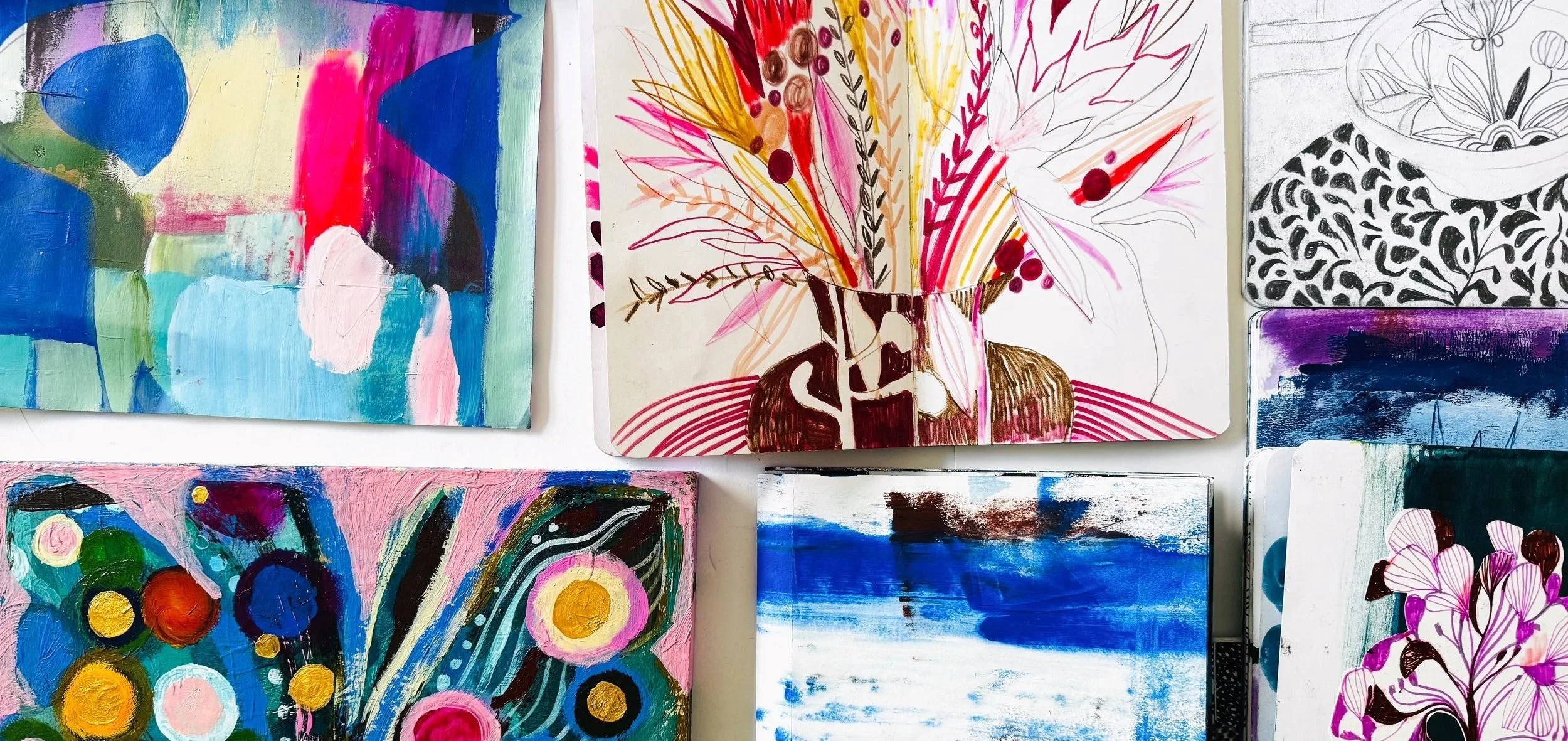
I decided to gather together all the sketchbooks I worked in this year and meander through them with an inquisitive and curious heart. To see what I thought, if anything occurred to me, to see if I could spot signposts for where to go next. To see if my art felt how I wanted it to feel.
Intention setting
This time last year I wrote a few words to help guide my art making in 2023. I defined how I wanted my art and art making to be:
Bold, playful and joyful
Brave and exciting
Unrestricted and unrestrained
Enthusiam and expansion
More exciting and more wild
I can’t say that I’ve nailed this brief. When I see my art gathered together like this, it does feel playful and joyful to me, however I think I have a long way to go in terms of bravery and wildness. I feel like I’m making small incremental moves in the right direction though…
Joining the dots
I often find that looking back helps me to look forward.
My sketchbooks are a safe place where I can store and record my art making and reflect upon it, sift through it and join the dots. My sketchbooks help me to better understand the things about my own art making which interest and fascinate me, the things about the world that interest and fascinate me.
Why I love sketchbooks
Sketchbooks are a place where I make art for myself. The pages are not necessarily filled with ‘sketches,’ the art is not necessarily a draft for something more important, although it can be, I think of my sketchbooks as a place where I experiment and express myself. Sketchbooks are where I gather together the hints, whispers and clues of my artistic practice. Sketchbooks are the filing cabinets for my art making. They are a place to collect and curate small delights and large curiosities. They are a place to make art for the joy of creating, a place to find a path through, problem solve, follow a thread. They are both a homecoming and an adventure…a safe harbour and an adventure playground.
Compound effect
I was slightly astonished by the quantity of work I’ve made in my sketchbooks this year.
I know, as a full-time artist, who is evangelical about sketchbooks and who also teaches sketchbook techniques, I am always going to have a lot of sketchbook work, but the amount surprised even me. I don’t work in my sketchbook every day, and it’s often an hour in the evenings whilst also doing something else. But I do consistently make time for my sketchbook, it’s a valuable practice for me and so I make time for it, even if this is small windows of time.
It is a good reminder that ‘little and often’ has a powerful compounding and cumulative effect. Small actions added together over a year add up to something significant…
Understanding our art by writing
Writing to gain insight and clarity…
I’m a great believer in writing things down. Sometimes the act of putting pen to paper can turn the intangible into the tangible. Asking ourselves questions and writing down our answers can help us to articulate our intentions and ideas to ourselves. It can help us find clarity when we are a little unclear. Our answers can also serve as a reminder and prompt along the way.
A sketchbook made from one piece of paper
One page sketchbooks
In this video I share how I use one page sketchbooks as art note books.
You can learn how to make a one page sketchbook here if you would like to.
Writing to understand
Writing about our art can help us to organise our thoughts, collect and capture ideas and can give us ideas when we are feeling under-inspired. Here are some questions you may like to use as prompts for your own writing:
What am I interested in exploring?
How do I want my art to feel?
What processes do I want to explore?
What do I want to start/stop doing in my art making?
What artist’s are currently calling to me and why?
What art materials do I want to use?
What advice do I need to give myself?
What can I do to nurture my creativity?
I like to keep adding to my one page notebook as ideas occur to me, I try and capture those fleeting observations before they escape. It creates a useful resource, a map of inspiration and ideas…
Making collages to inspire paintings
Making collages to inspire paintings…
In this video I share a process I use to help me find new ideas and compositions…
CREATING COLLAGES
I make photocopies of things I’ve created, such as pages in my sketchbook, I collect together abandoned drawings, and offcuts and oddments from my art practice and I use all these pieces and fragments to create temporary collages which I then photograph.
The photographs are then used to inspire further drawings and paintings and then those drawings and paintings might be used to inspire something else…its a creative stepping stone.
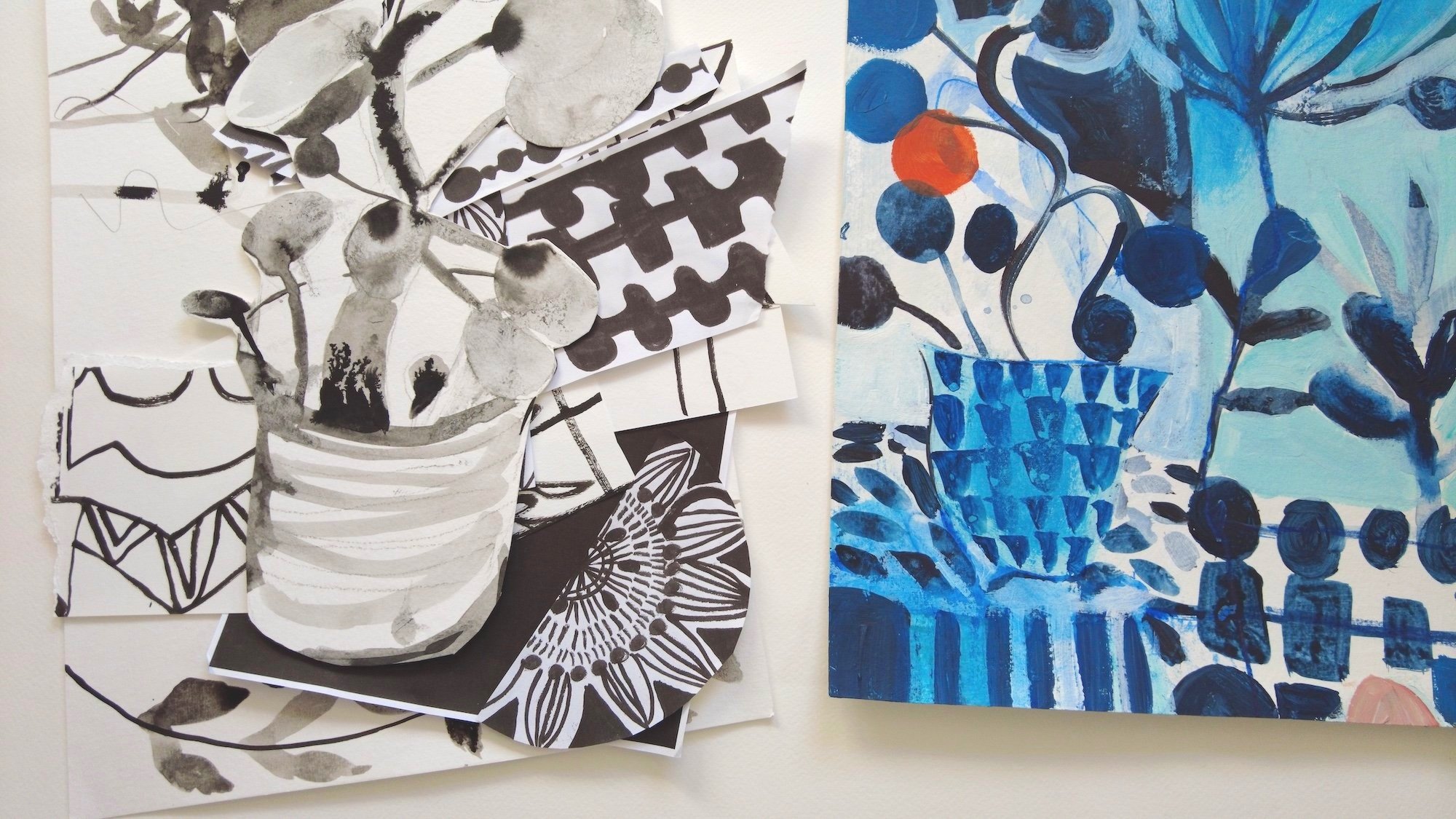
A temporary collage made from old drawings, and photocopies of things I’ve created
FOLLOWING A BREADCRUMB TRAIL
Art making is often like following a breadcrumb trail through the forest to an unknown destination… I never quite know which path will lead to something magical and which will lead to a dead-end. I like the fact that making art can feel like a journey into the unknown...
A painting in my sketchbook (left) inspired by a collage made from pieces of an old magazine (right).
COLLAGES MADE FROM MAGAZINES
If you don’t have offcuts of your own art to use to create a collage, you could try with pieces cut from a magazine.
Above is a small collage I’ve created by cutting interesting bits and bobs out of a magazine.
Creating a composition from random found shapes and pieces is like constructing a puzzle… it involves lots of questioning and thought and is not always as easy as it may appear. ‘Does this look balanced? Is this interesting? Is it too busy? Is it too boring? Does it work as a unified whole? The sort of questions you need to ask when creating any art work are tested by this type of excercise. In all these experiments, I’m seeking discoveries, learnings, revelations…flexing my creative muscles.
I believe most artist’s have a seeker’s soul. Looking for fragments of ideas, trying to figure things out, attempting to join the dots, make connections, piecing things together to better understand themselves and the world around them. Trying to find out who they are as artists and how they want their art to look, feel and be in that moment…
This mindset shift which has helped the most…
Some thoughts on mindset and expectations…
Music credit: Ludlow, Masterpiece of Mess
In this video I talk about how my art making changed dramatically when I stopped concentrating on the flaws in everything I created and started appreciating and seeking the things I loved about my own art. This change allowed me to appreciate my personal sensibilities, tune into what made my art feel like mine and improve my skills.
I love this quote from Ira Glass, the American writer and broadcaster. It is about writing but is true and applicable to all forms of creativity…
“All of us who do creative work, we get into it because we have good taste. But there is this gap. For the first couple of years you make stuff, it’s just not that good. It’s trying to be good, it has potential, but it’s not. But your taste, the thing that got you into the game, is still killer.
And your taste is why your work disappoints you. A lot of people never get past this phase, they quit. Most people I know who do interesting, creative work went through years of this. We know our work doesn’t have this special thing that we want it to have.
We all go through this. And if you are just starting out or you are still in this phase, you gotta know it’s normal and the most important thing you can do is do a lot of work.
Put yourself on a deadline so that every week you will finish one story. It is only by going through a volume of work that you will close that gap, and your work will be as good as your ambitions. And I took longer to figure out how to do this than anyone I’ve ever met. It’s gonna take awhile. It’s normal to take awhile. You’ve just gotta fight your way through.”
IRA GLASS QUOTED IN 2009 WHEN TALKING ABOUT THE THE ART OF STORYTELLING ON CURRENT TV
This idea is true not just for beginners but for everyone who is at a point of transition, or trying something new or integrating a new process into their existing approach.
Our ambitions can be greater than our abilities and that is just part of the creative process…my advice is to keep going and keep paying close attention to what you like, enjoy and care about in your own work…