Art making ideasi

Ideas. Inspiration. A little creative mischief.

If you’re drawn to abstract and semi-abstract art, sketchbooks, colour and a little creative mischief, this is your corner of the internet.

Here you’ll find stories, videos, inspiration, art making advice and gentle nudges to help you create art that feels exciting to you.

A year of sketchbooks

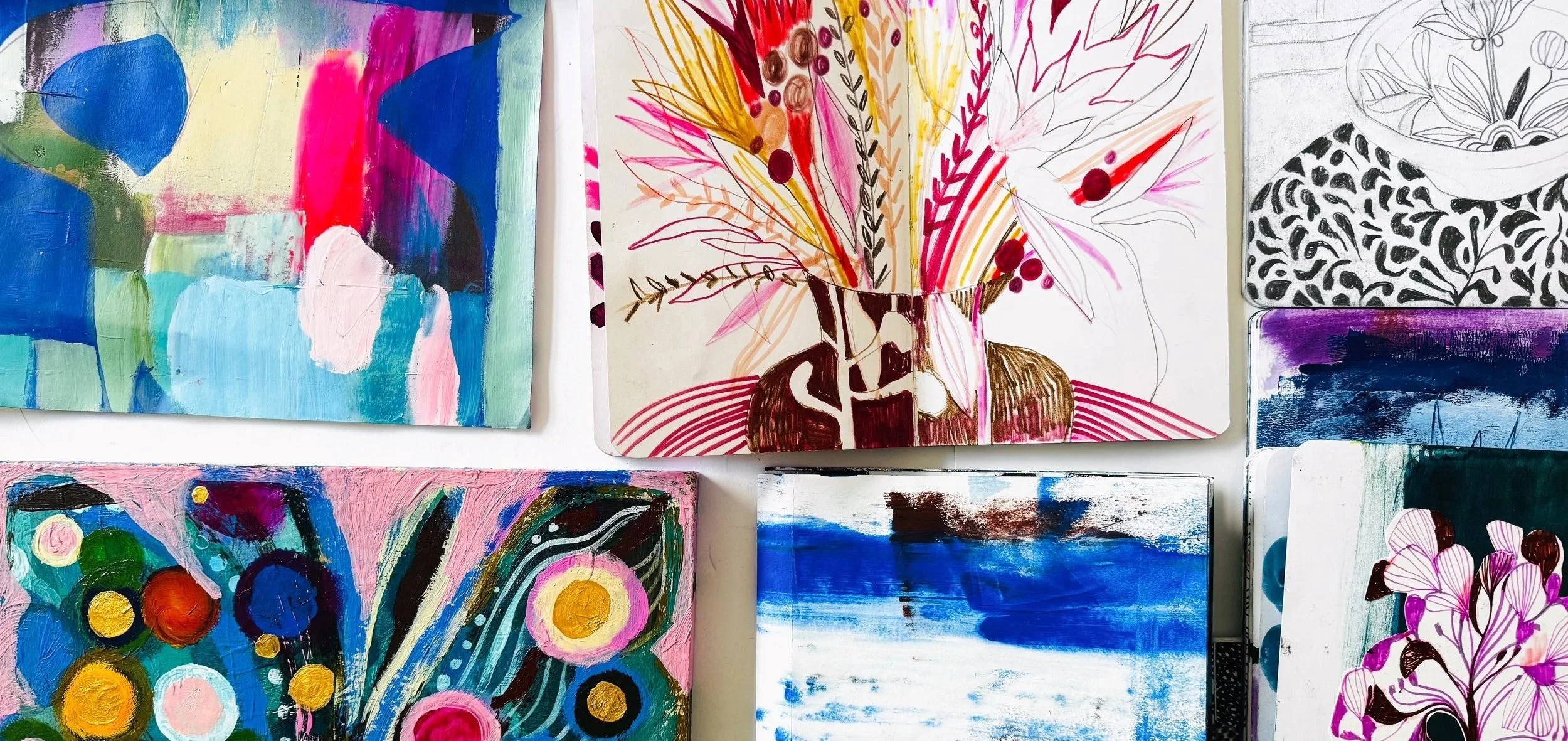
A year of sketchbooks and thinking about art intentions…

In these videos and blogs I like to share what I’m up to in my art practice and as the year draws to a close I find myself in a reflective mood.

I decided to gather together all the sketchbooks I worked in this year and meander through them with an inquisitive and curious heart. To see what I thought, if anything occurred to me, to see if I could spot signposts for where to go next. To see if my art felt how I wanted it to feel.

Intention setting

This time last year I wrote a few words to help guide my art making in 2023. I defined how I wanted my art and art making to be:

  • Bold, playful and joyful

  • Brave and exciting

  • Unrestricted and unrestrained

  • Enthusiam and expansion

  • More exciting and more wild

I can’t say that I’ve nailed this brief. When I see my art gathered together like this, it does feel playful and joyful to me, however I think I have a long way to go in terms of bravery and wildness. I feel like I’m making small incremental moves in the right direction though…

Joining the dots

I often find that looking back helps me to look forward.

My sketchbooks are a safe place where I can store and record my art making and reflect upon it, sift through it and join the dots. My sketchbooks help me to better understand the things about my own art making which interest and fascinate me, the things about the world that interest and fascinate me.

Why I love sketchbooks

Sketchbooks are a place where I make art for myself. The pages are not necessarily filled with ‘sketches,’ the art is not necessarily a draft for something more important, although it can be, I think of my sketchbooks as a place where I experiment and express myself. Sketchbooks are where I gather together the hints, whispers and clues of my artistic practice. Sketchbooks are the filing cabinets for my art making. They are a place to collect and curate small delights and large curiosities. They are a place to make art for the joy of creating, a place to find a path through, problem solve, follow a thread. They are both a homecoming and an adventure…a safe harbour and an adventure playground.

Compound effect

I was slightly astonished by the quantity of work I’ve made in my sketchbooks this year.

I know, as a full-time artist, who is evangelical about sketchbooks and who also teaches sketchbook techniques, I am always going to have a lot of sketchbook work, but the amount surprised even me. I don’t work in my sketchbook every day, and it’s often an hour in the evenings whilst also doing something else. But I do consistently make time for my sketchbook, it’s a valuable practice for me and so I make time for it, even if this is small windows of time.

It is a good reminder that ‘little and often’ has a powerful compounding and cumulative effect. Small actions added together over a year add up to something significant…

Read More

One page sketchbooks

Making a small sketchbook from one piece of paper

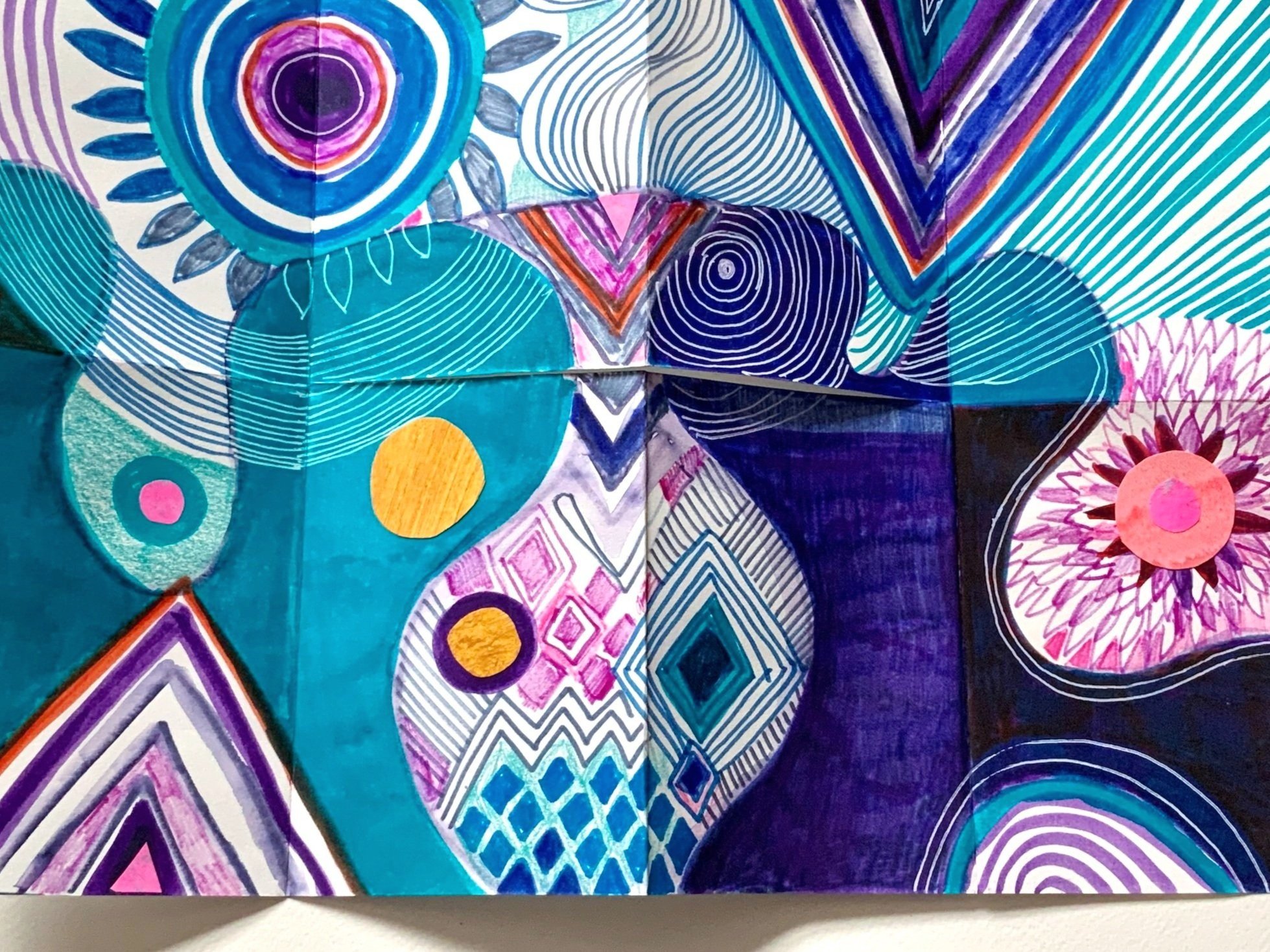
In this video I show you how to make a simple sketchbook from one piece of paper and a way to tidy them up by gluing and cutting.

I make these simple one page sketchbooks very frequently and have for many years. There is something extremely tactile and pleasing about their intimate scale. I like the fact that it’s just one piece of paper, no pressure, no expectations, it feels expansive and freeing.

The great thing is that you can make them from any paper you have, I happen to have a lot of heavy watercolour paper (350gsm) and I use that but you can use what you have to hand, you could even use cheap computer paper. These sketchbooks end up with 8 sides, so the end result will always be an eighth of the size of the paper you started with…

I sometimes begin the art work before the page is folded into a sketchbook, there is something about the surprising and unexpected compositions that come with the folding which I enjoy.

I’ve made them from abandoned drawings or from scrap pieces of paper, reusing and recycling and making something from not very much. I might take a painting that hasn’t quite worked and use it for the start of one of these art books, adding collage, painting over sections, turning the unloved into the loved.

Thank you to artist Sue Brown for the idea of gluing these sketchbooks. you can of course just make them by folding and one cut if you want to keep them super simple (the gluing helps if you are using thicker paper and want to neaten them up, because thick paper doesn’t fold as well and so the end result can get a little wonky.)

Read More

Understanding our art by writing

Writing to gain insight and clarity…

I’m a great believer in writing things down. Sometimes the act of putting pen to paper can turn the intangible into the tangible. Asking ourselves questions and writing down our answers can help us to articulate our intentions and ideas to ourselves. It can help us find clarity when we are a little unclear. Our answers can also serve as a reminder and prompt along the way.

A sketchbook made from one piece of paper

One page sketchbooks

In this video I share how I use one page sketchbooks as art note books.

You can learn how to make a one page sketchbook here if you would like to.

Writing to understand

Writing about our art can help us to organise our thoughts, collect and capture ideas and can give us ideas when we are feeling under-inspired. Here are some questions you may like to use as prompts for your own writing:

  • What am I interested in exploring?

  • How do I want my art to feel?

  • What processes do I want to explore?

  • What do I want to start/stop doing in my art making?

  • What artist’s are currently calling to me and why?

  • What art materials do I want to use?

  • What advice do I need to give myself?

  • What can I do to nurture my creativity?

I like to keep adding to my one page notebook as ideas occur to me, I try and capture those fleeting observations before they escape. It creates a useful resource, a map of inspiration and ideas…

Read More

Inside the art journal of Frida Kahlo

The visual journal of Frida Kahlo…

THE DIARY OF FRIDA KAHLO: AN INTIMATE SELF PORTRAIT

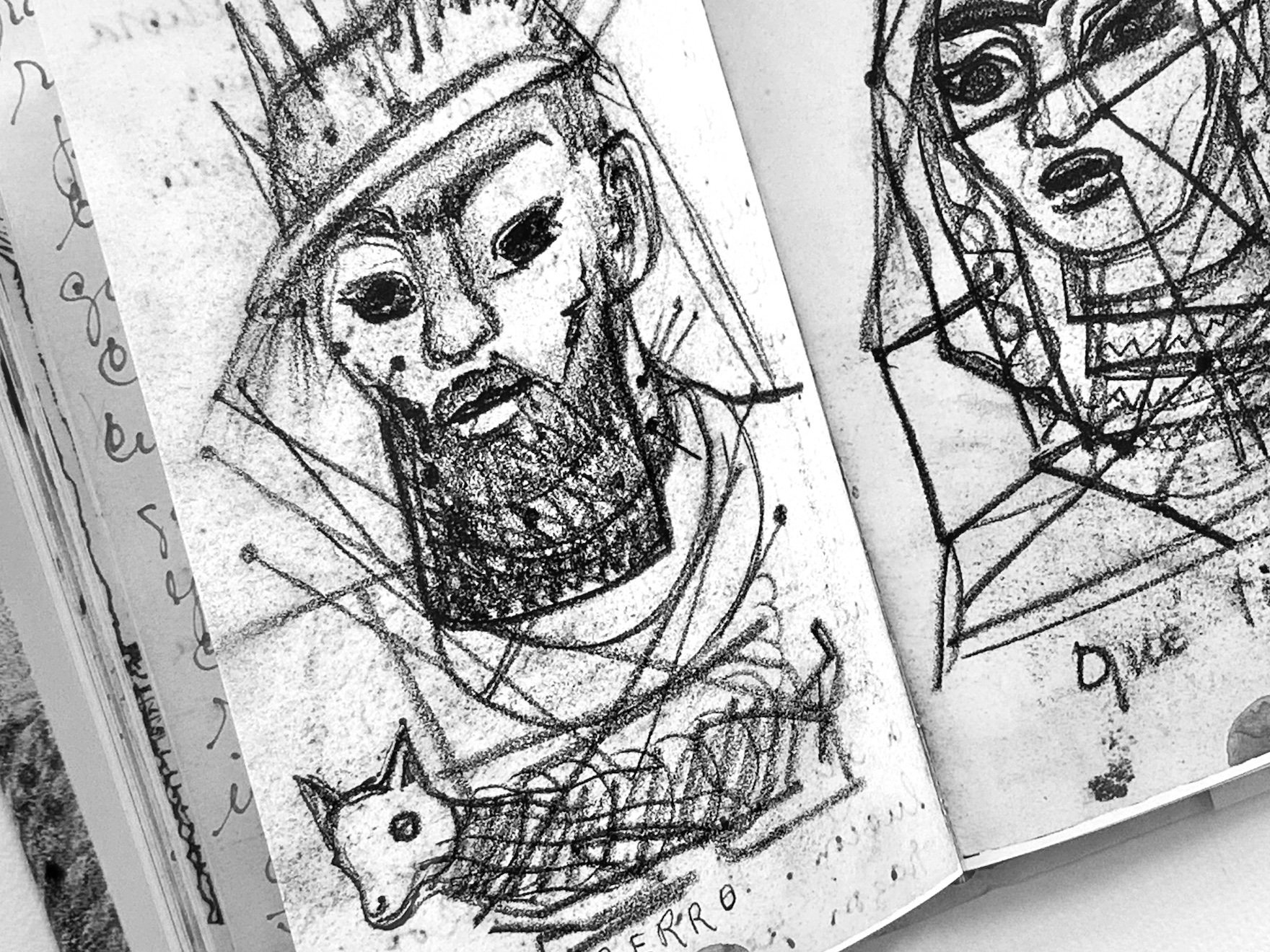
In this video I take you inside the art journal or visual diary of the artist Frida Kahlo. I share the book: The Diary of Frida Kahlo: An Intimate Self Portrait published in 1995 by Abradale Press an in-print of Abrams Books, with subsequent reprints in later years. You can read more about this book on the publisher’s website, it is still in print today…

It’s a book which I come back to time and again.

Frida Kahlo, one of the most iconic artists of the 20th century, was born in Mexico in 1907 and is famous for her self-portraits, characterised by vibrant colours and powerful symbolic imagery,

This book fully replicates 170 pages of her visual journal or sketchbook. She worked in the book for the last ten years of her life between circa 1945 and 1955 and it gives a intimate insight into the woman and the artist.

INTROSPECTION AND EXPRESSION

Her diary or sketchbook, I think, reflects both a deep introspection and bold self-expression. She has clearly used this book as a means of exploring her inner thoughts, emotions, and personal experiences, her identity and her place in the world.

IMAGERY AND SYMBOLISM

It’s packed with symbolic imagery, metaphors, personal, political, religious and cultural iconography all patch-worked together.

Pages from Frida Kahlo’s visual diary

EXPLORATION AND EXPERIMENTATION

It also shows all sorts of artistic exploration and experimentation, she mixes up various techniques, styles, and art materials. She combines elements of realism, surrealism with symbols and motifs to create a visually rich, and at times bewildering and beguiling whole.

I think she is exploring her personal pain and suffering and yet it also clearly demonstrates her magnificent wit, playful spirit and vibrancy…

Her journal feels like a significant work of self-expression, resilience and creativity…and I think it’s just fascinating.

Read More

Art materials: felt tip pens

Some of my favourite felt-tip pens

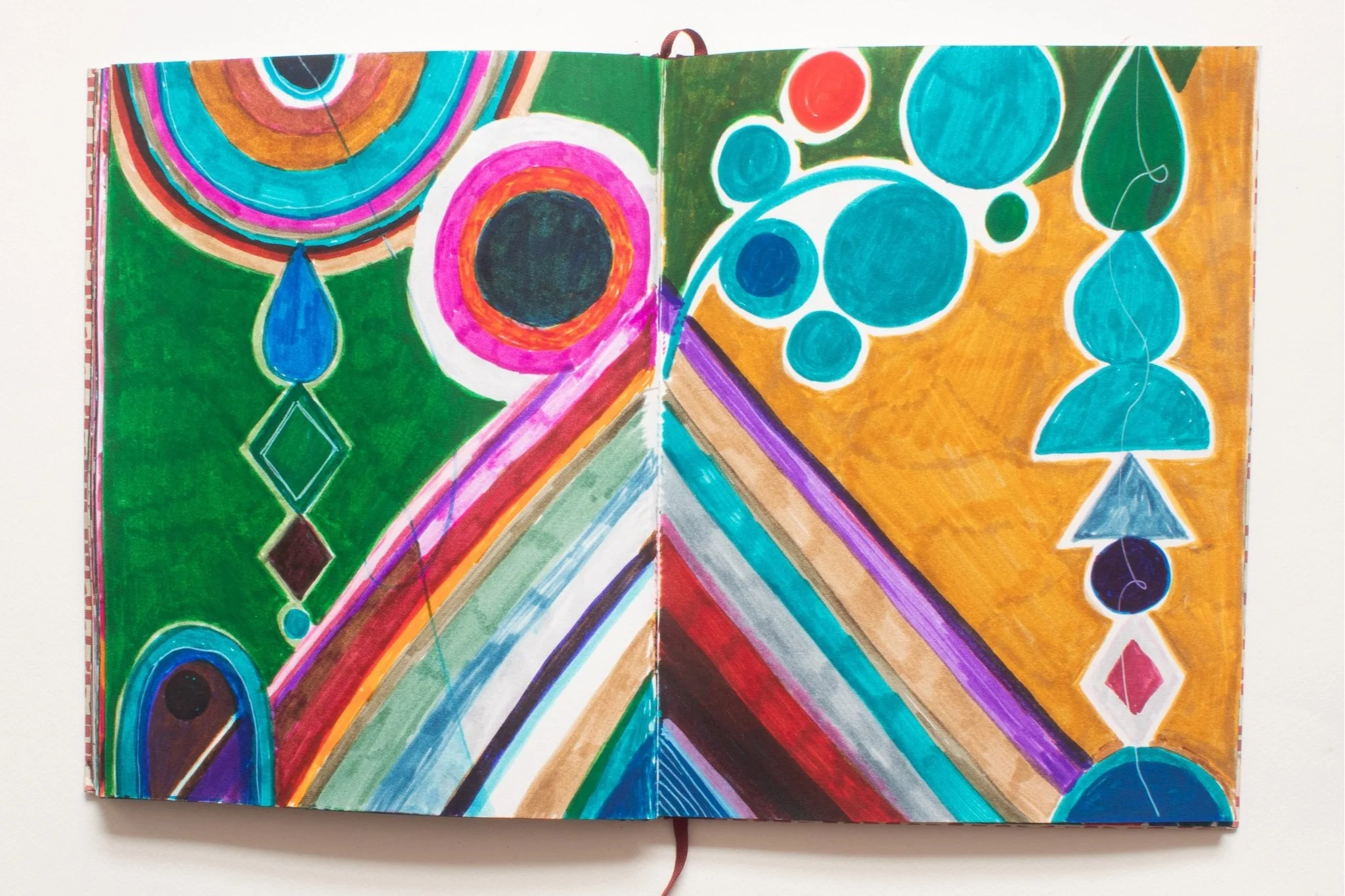
In this video I share some thoughts about using markers and felt tip pens in my sketchbook and share some of my favourites.

I really enjoy using this type of pen in my sketchbook practice, they are quick, portable and accessible. There is something playful, easeful and joyful about them. The brilliantly bright colours seem cheerful, optimistic and exuberant to me.

ART MATERIALS

Here are some of the felt tip pens I like to use, these are just my personal preferences, I tend to mix and match brands to find the colours I like. You may like to explore adding multiple layers of colour on top of each other to build up intensity and get a more unusual colour palette or experiment with combining felt tips pens, with other art materials such as collage and paint…

I mostly use water-based or indian ink based pens in my sketchbook, I find that alcohol based markers always seem to seep through to the page beneath no-matter the paper quality and I find their smell a little overpowering, so I mostly used water based….

These are the brands I use most often:

  • Pentel Pocket Brush Pen ( this is the black brush pen I use the most which is refillable)

  • Ecoline Brush Pens ( these pens can be refilled with Ecoline liquid watercolour which comes in bottles)

  • Faber Castell PITT Artist Pens (indian ink based so waterproof)

  • Stabilo Pen 68 BRUSH

  • Staedtler 3001 double ended watercolour brush pen

  • TomBow ABT Dual Brush Pens

    The Faber Castell and Tombow’s are the more expensive high-end ones, they are not cheap, but as a professional artist I do invest in materials. The Staedtler ones I find to be really good quality and excellent value. The Ecoline pens can be refilled. Please don’t feel you need to start with expensive pens, the best felt tip pens to use are always the ones you already own…(or perhaps the ones your kids or grandchildren own!)


Read More